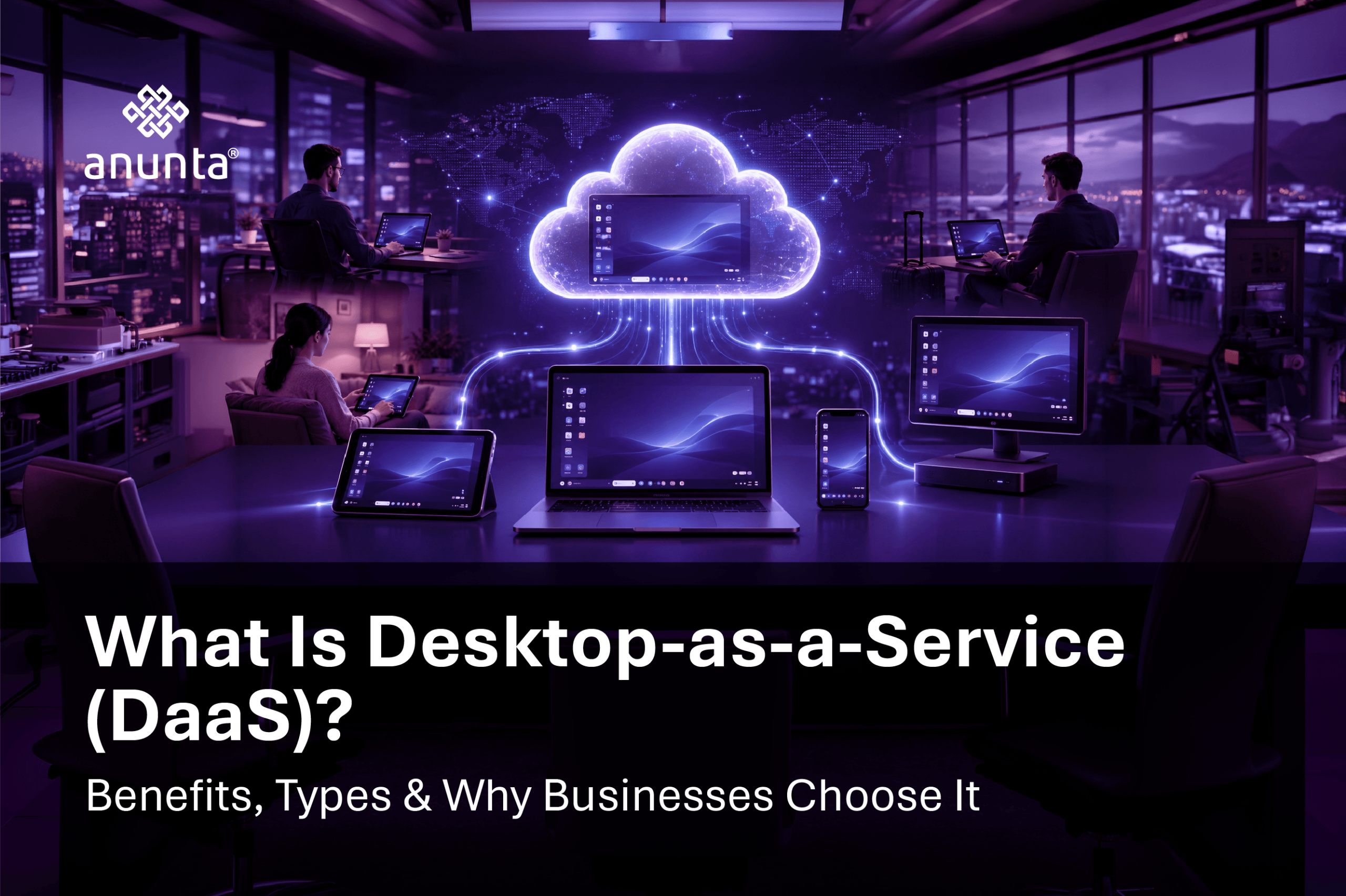
The entirety of your work has expanded beyond the confines of the physical walls you once knew as home. Teams today can work with similar urgency and fluidity around their employer’s networks, across multiple cities, with multiple devices, and on multiple time zones; however, in many companies, traditional, fixed desktop infrastructure has not been able to support that expansion.
Desktop-as-a-Service (DaaS) is changing the way your company operates and the ability to scale your business.
DaaS is the most basic, simple form of delivering a full desktop through a cloud provider, eliminating any reliance on physical equipment or the need for operational burden in providing employees access to secure, consistent desktops at all times, from any location.
We will discuss what Desktop-as-a-Service actually is, how it works, the different types of DaaS platforms available, and why so many organizations are beginning to take advantage of it. Furthermore, we will also highlight some of the successful results from actual customer success stories that we have highlighted with Anunta.
The Desktop-as-a-Service (DaaS) model is when desktops, applications, data, and infrastructure are provided as a managed service from the cloud. Users can connect to their system from any device and will see a completely functional desktop that has been streamed from the cloud in a secure manner.
In contrast to having organizations own their own on-premises infrastructure via VDI, the provider assumes responsibility for the infrastructure in the DaaS model. This reduces the capital investments that organizations would normally have to make with a predictable subscription
model and eliminates any administrative burden associated with maintenance, patching, or scaling.
DaaS is built on an architecture that is elegant in its simplicity; the environment is hosted in the cloud by a provider such as Azure or AWS, session delivery is managed by a broker, and user access is secured through identity systems. However, the user does not experience any complexity; they simply log in and begin working.
In one case, a global bank, wealth management, and insurance (BFSI) enterprise with over 12 countries deployed managed DaaS after transitioning from legacy VDI. Within six months of implementing DaaS, the infrastructure overhead was reduced by 31% compared to the previous year, and log-in times were improved by 45% from when they were using legacy VDI. This was not just a technical shift; it was also a cultural shift that changed how teams had access to their digital workspace and built trust in it.
The magic of DaaS lies in how seamlessly it disappears into the background.
A user connects through a browser or thin client. The request flows to a secure broker. Authentication is handled through SSO and MFA. Once verified, a virtual desktop session is provisioned instantly and streamed to the user’s device.
Under the hood, multiple layers operate in harmony. Hypervisors manage compute resources. Session controllers ensure performance. Application layers deliver tools without local installation.
Platforms like Citrix Virtual Apps and Desktops and Azure Virtual Desktop power these environments, but orchestration is where the real value lies.
A leading healthcare provider in Southeast Asia needed to scale secure access for over 8,000 clinicians during a rapid expansion phase. Anunta deployed a managed Desktop-as-a-Service environment that ensured uninterrupted access to patient systems across locations. The result was zero downtime during onboarding and a 37 percent reduction in IT support tickets.
The experience remained consistent. The device became irrelevant. Performance became predictable.
Each organization’s cloud migration experience is unique, and Desktop-as-a-Service (DaaS) embodies this uniqueness by offering flexible ways to deliver DaaS.
As an example, Anunta helped a major insurance company implement a hybrid DaaS solution. Core underwriting applications stayed within their proprietary environment, while the customer-facing groups moved to cloud-based desktops. As a result, the organization saw a 29% increase in processing efficiency and shorter response time at each customer interface.
Additionally, an organization can deploy the same software in two different ways: persistent and non-persistent desktops. Persistent desktops can be personalised by each user; non-persistent desktops maintain uniformity. The choice between these two types of desktops should be based on the user’s role, not on any assumptions.
Desktop-as-a-Service is best understood by looking at the results rather than just the features.
With Anunta’s managed service approach, these examples are not just promises but rather engineered outcomes that are continuously improved through real-time monitoring and full lifecycle ownership.
The next chapter of Desktop-as-a-Service is being written by intelligence.
AI in DaaS introduces predictive capabilities that transform operations. Systems analyze usage patterns and allocate resources before demand spikes. Performance issues are identified and resolved before users notice.
Anunta integrates AI-powered monitoring into its managed environments. In one enterprise deployment, predictive analytics reduced performance-related incidents by 38 percent within six months.
Security becomes sharper. AI detects unusual login behavior and flags anomalies in real time. Automation handles patching, updates, and image management with precision.
The result is a desktop experience that feels effortless because complexity is handled invisibly.
The momentum behind DaaS is driven by necessity, not novelty. Hybrid work has become permanent. Organizations need infrastructure that adapts instantly to distributed teams. Learn more about this shift through hybrid work strategies.
At the same time, IT skill shortages are widening. Managing complex environments internally is no longer sustainable. Businesses are turning to managed DaaS to access expertise without expanding internal teams.
Industry projections reinforce this shift. Analysts estimate that cloud-delivered desktops will continue to grow at double-digit rates as enterprises prioritise flexibility, security, and cost control.
Sustainability also plays a role. Reduced reliance on physical hardware supports ESG goals while optimizing energy usage.
Desktop-as-a-Service is not just a technology shift. It is a shift in control, from infrastructure constraints to operational freedom.
When executed right, it does more than deliver desktops. It delivers clarity, continuity, and confidence.
Anunta approaches Desktop-as-a-Service with clarity and conviction.
With deep expertise across Citrix, Omnissa Horizon, and Azure ecosystems, Anunta delivers platform-agnostic solutions tailored to enterprise needs. Its 24×7 proactive operations ensure stability, security, and performance across environments.
AI-enhanced monitoring, lifecycle ownership, and proven enterprise deployments make Anunta a trusted partner for organizations navigating complex digital workplace transformations. Explore Anunta’s managed DaaS solutions or speak with our team to begin your journey.
Ready to take the next step? Request a Free DaaS Assessment and discover what your workplace could truly become.
Q1: What is Desktop-as-a-Service (DaaS) in simple terms?
A: Desktop-as-a-Service (DaaS) is a cloud-based solution where your desktop environment — including the operating system, applications, and files — is hosted and managed in the cloud and delivered to you over the internet. Instead of running software on a physical PC, you access your full desktop from any device, anywhere, through a secure connection.
Q2: What is the difference between DaaS and VDI?
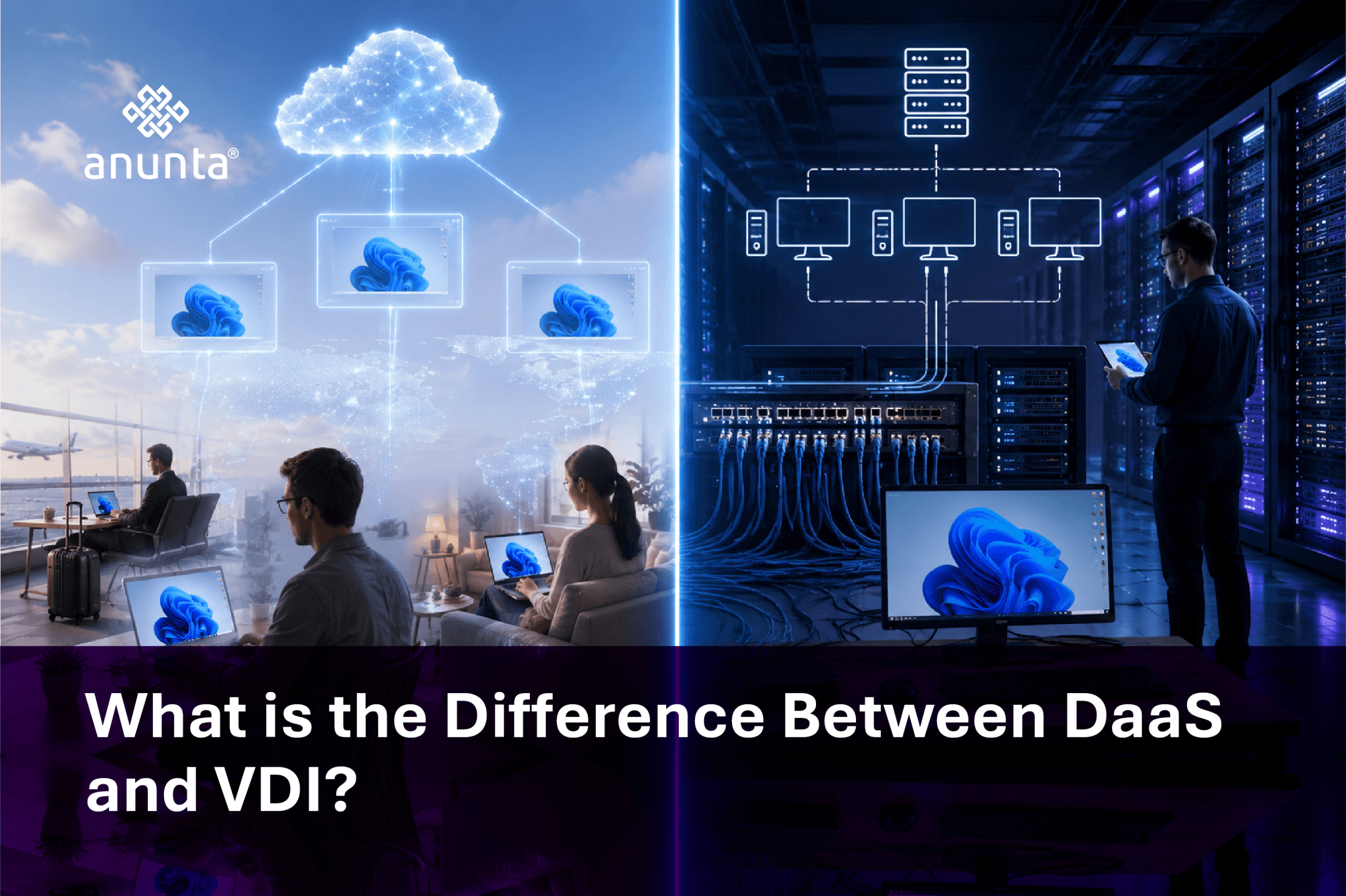
A: VDI (Virtual Desktop Infrastructure) is a technology that virtualises desktops but is typically owned and managed on-premises by your IT team. DaaS is VDI delivered as a cloud-managed service — the provider handles the hardware, software, maintenance, and support. VDI requires capital investment and internal expertise; DaaS converts that to a predictable per-user subscription with operational management included.
Q3: Is Desktop-as-a-Service (DaaS) secure?
A: Yes — DaaS is inherently more secure than traditional endpoint computing in most environments. Because data is stored centrally in the cloud rather than on physical devices, lost or stolen devices don’t expose company data. Enterprise DaaS platforms support MFA, SSO, zero-trust network access, and end-to-end encryption. Managed DaaS providers like Anunta also apply continuous security patching and real-time threat monitoring.
Q4: How does AI in DaaS improve the user experience?
A: AI in DaaS enables proactive, intelligent management of the virtual desktop environment. AI analyzes usage patterns to predict and pre-allocate compute resources before demand spikes, monitors session quality to flag degradation before users notice, and detects anomalous login behavior to surface security threats in real time. The result is a smoother, faster, and more reliable desktop experience with fewer