In most enterprise environments, compliance failures are rarely caused by a lack of tools or defined policies.
They occur because control is not consistently enforced where it matters most.
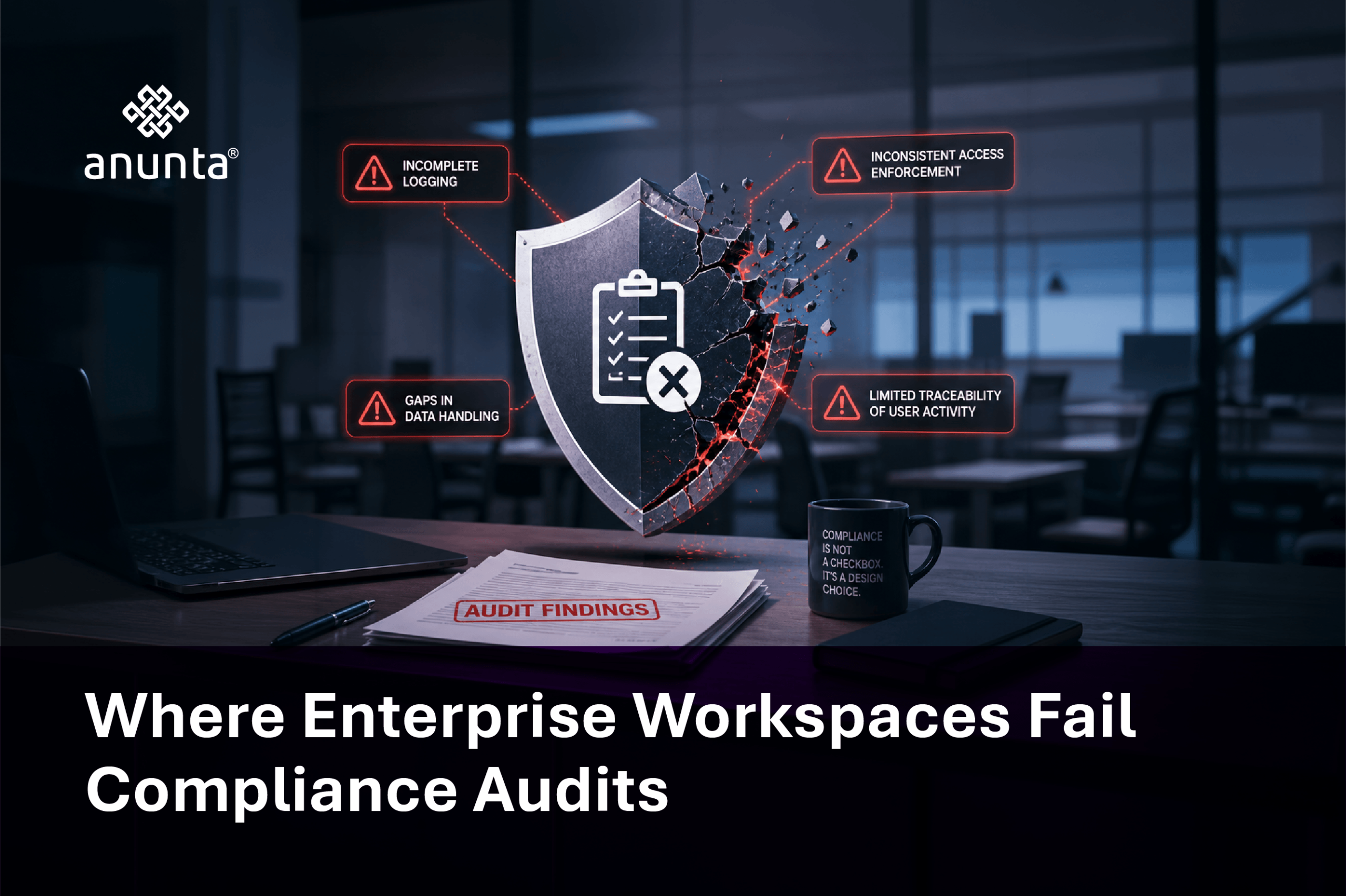
Across audit reports, the findings may vary in wording, but the underlying pattern is consistent:
These are not isolated issues.
They point to a deeper structural problem.
The digital workspace is not designed to enforce compliance by default.
This is precisely where Sovereign Cloud models are gaining traction, as they are designed to enforce control within defined boundaries at the workspace level, rather than relying on fragmented enforcement across systems.
Many organizations operate with a high degree of confidence in their compliance posture.
This confidence is typically based on:
However, audit readiness is often reconstructed rather than continuous.
Logs are aggregated from multiple systems. Events are correlated manually. Exceptions are identified and addressed during audit cycles.
This creates a model where compliance is demonstrated through effort rather than built into the system.
This model of reconstructed compliance is increasingly unsustainable, leading organizations to evaluate Sovereign Cloud-based workspace environments, where auditability is continuous and built into how systems operate.
Modern enterprise environments include a mix of:
Each of these environments introduces variability.
Policies that are defined centrally are not always enforced uniformly across endpoints.
This results in:
When endpoints operate outside a controlled workspace model, compliance becomes dependent on user behavior rather than enforced policy.
Access governance is often defined at a central level.
In practice, enforcement varies across:
Common issues include:
This fragmentation increases the risk of unauthorized access and makes it difficult to demonstrate consistent enforcement during audits.
Data residency is frequently treated as a storage-level requirement.
Organizations ensure that data is hosted within approved regions.
However, during actual usage:
Without enforcing data boundaries within the digital workspace, compliance exposure remains.
These gaps are difficult to address without a controlled environment. Sovereign Cloud architectures provide this by ensuring that data access, processing, and interaction are confined within governed boundaries.
Audit readiness depends on the ability to accurately trace user activity.
In many environments:
As a result:
Continuous auditability requires centralized, real-time visibility into user activity.
Enterprises invest heavily in:
These tools provide visibility and alerting capabilities.
However, they do not define how environments are structured.
Without a standardized digital workspace, tools operate in isolation.
This leads to a situation in which organizations can detect issues but cannot consistently prevent them.
This is where Sovereign Cloud-aligned workspace models differentiate themselves, by integrating control directly into the environment rather than relying on disconnected tools.
Many organizations continue to rely on legacy virtual desktop environments.
These environments were designed for:
They were not designed for:
Over time, these environments become difficult to manage, leading to configuration drift and reduced control.
Across enterprises, these issues follow a consistent structure:
This is not a tooling issue.
It is a design issue.
Addressing these systemic issues requires more than incremental fixes. It requires a shift toward Sovereign Cloud-based control models, where compliance is enforced through architecture rather than coordinated across layers.
Organizations that consistently meet audit requirements take a different approach.
They enforce compliance at the workspace layer.
This includes:
In these environments, compliance is not reconstructed.
It is inherent in how the system operates.
Enterprise teams should be able to answer the following with confidence:
If the answer to any of these questions is uncertain, compliance risk exists.
A Sovereign Cloud approach enables organizations to move away from reactive, audit-driven compliance toward a model where control is continuous, centralized, and enforceable at the workspace level.
A single issue rarely causes compliance failures.
They emerge from a fragmented control pattern at the workspace layer.
As environments become more distributed and complex, these gaps become more visible.
A controlled digital workspace is no longer an optimization; it is a necessity.
It is a requirement for achieving and sustaining compliance.