The board of directors’ quarterly review is being held. Once again, the CIO has presented a fairly predictable report. The state of the enterprise technology environment continues to show stability in uptime, with security compliance maintained and service desk metrics remaining well within expected parameters. As in prior quarters, every dashboard used to monitor operations shows a positive status.
However, as is often the case, there is some disconnect between the dashboard data and what is actually happening in the business. For example, integrating a new acquisition can take several months; business units are purchasing software independently of the enterprise; employee experience has been inconsistent across various locations; and every new initiative requires a level of effort much greater than anticipated.
At Anunta, we continue to see this pattern regularly with large enterprise clients. Despite substantial investments in technology solutions since 2020, most organizations are still facing the same operational challenges they had 3-4 years ago. The problem is not outlay; it is alignment.
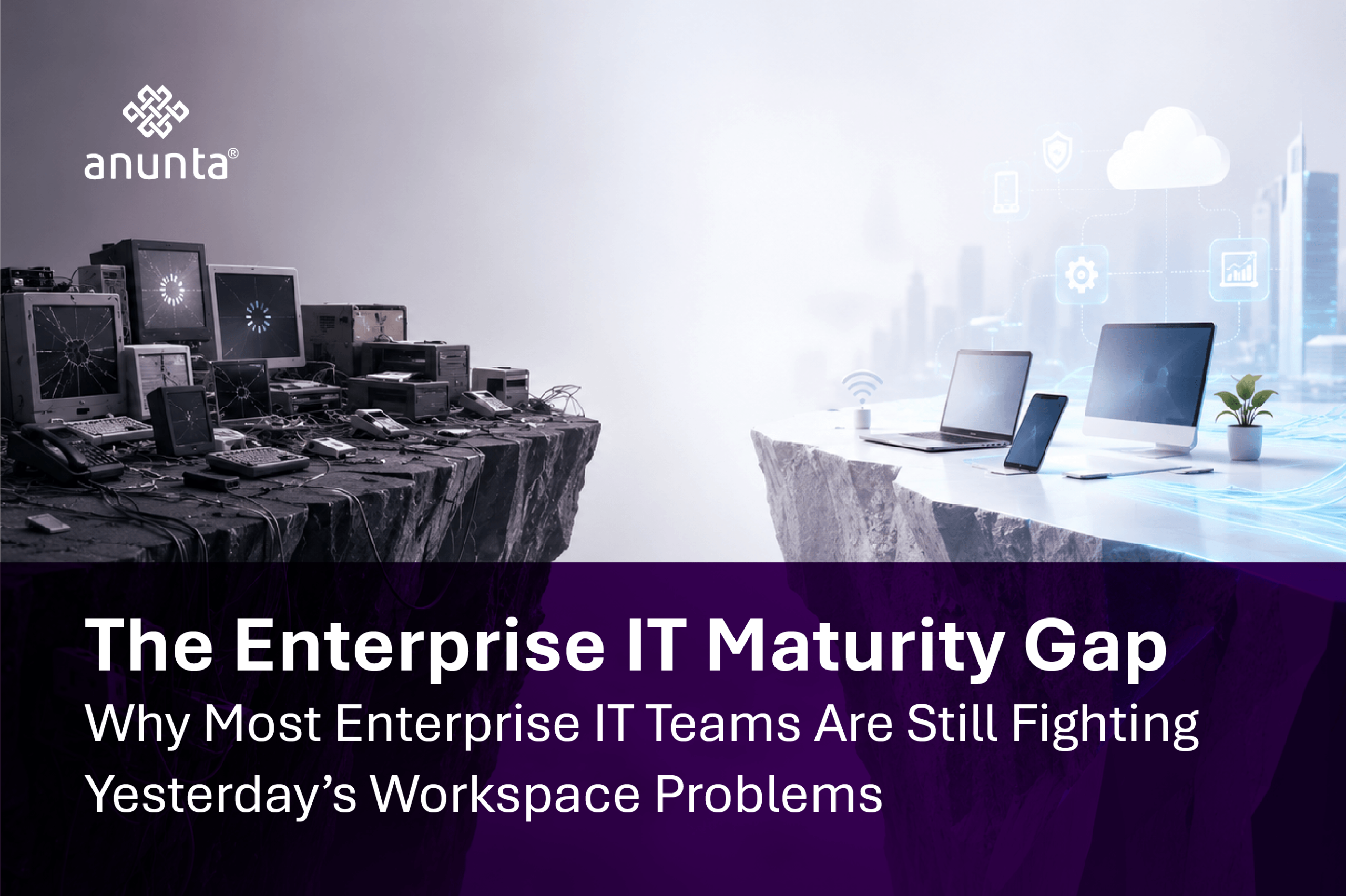
The enterprise IT maturity gap is the distance between where IT operates and where the business runs. Closing this gap has become a strategic imperative in successful CIO IT modernization strategies.
Anunta sees a continual disconnect between how IT operates today and how modern companies operate. IT organizations have changed their technology stacks, and the workforce has significantly changed its expectations; however, governance models have not evolved.
The maturity gap is the distance between where your IT operating model works and where your business runs. Closing that gap has become a defining priority in a successful CIO IT modernization strategy.
IT leaders in most enterprises have inherited operating models from an earlier time when enterprises were very different. Hybrid work has now become the norm for nearly all enterprises; there has been an acceleration in the adoption of cloud services; SaaS applications have increased exponentially; employees have become more remote; many organizations are now incorporating new technologies into existing foundations rather than beginning with new architecture for their workspace.
What Anunta refers to as “infrastructure scar tissue” is formed because every new solution or service provided solves an immediate need, but collectively these solutions create a web of complexity that hinders the speed of modernization.
In environments being managed by Anunta, multiple endpoint management platforms, duplicate security tools across multiple vendor platforms, overlapping collaboration suites, and broken governance processes are routinely encountered.
When viewed in isolation, each previous investment made by any enterprise may be justified. However, when viewed collectively, these investments represent an ever-increasing burden of workplace technology debt.
Research from both Productiv and Gartner consistently demonstrates that SaaS sprawl is rapidly becoming one of the most significant governance challenges enterprises face. There are now numerous enterprises managing over 100 SaaS applications, yet they have very little governance visibility into the applications they use.
The problem is not under-investment, but the accumulation of IT operational debt at the enterprise level, which leaders have inherited from years of adding to IT assets without removing them.
CIOs did not fail to invest in their IT infrastructure; most enterprises fail to decommission IT assets once they have served their useful life.
These are not operational failures. There are signs that yesterday’s architecture is still steering today’s business.
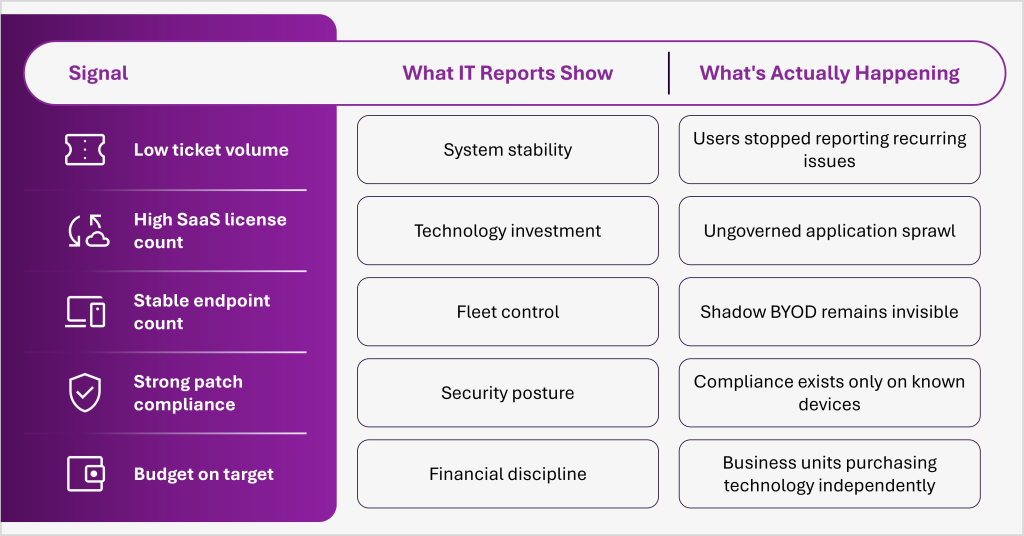
Traditional IT dashboards excel at measuring activity. They struggle to measure maturity because Enterprise Workspace Governance lacks visibility.
Many of the most significant maturity indicators may exist in the gaps between all these metrics, such as unused software licenses, duplicate applications, shadow procurement, ungoverned devices, or department-led technology purchases.
In our work with various organizations, Anunta has noticed that they may celebrate the operational stability they’ve achieved. At the same time, however, they do not understand the extent and complexity of governance that has quietly grown.
A clear indicator that this type of ungoverned complexity exists within an organization is when a business unit sources a technology solution without involving IT. These actions are usually viewed by IT as compliance issues; in fact, they are a failure of governance visibility.
Based on years of enterprise assessments, Anunta calls this threshold the Governance Visibility Horizon. It marks the point at which technology decisions begin occurring beyond IT’s structured field of view. Once organizations cross this horizon, technology spending, security risk, and operational complexity begin growing faster than governance capability.
This is precisely why forward-looking CIOs are investing in Digital Employee Experience analytics and operational intelligence platforms. Visibility is no longer about infrastructure. It is about decision-making.
Organizations typically track their technological expenditures, but far fewer track how quickly they innovate. Technology velocity is now a primary source of competitive advantage.
At Anunta, we support our clients with low levels of Information Technology maturity. Generally, they take far longer than their more mature peers to support new capabilities, integrate acquisitions, deploy application services, or create a unified Global Workspace.
For example, Anunta recently assisted a multinational manufacturing client operating in more than 30 countries. Their operational metrics showed a strong picture of operational effectiveness. However, integrating their acquisitions took a long time – in many instances, months – because of inconsistent endpoint governance, different standards for workspaces, inconsistent security policies, and disparate application management across the various regions.
The company had sufficient technology and adequate people to do the work, but they were fragmented in how they operated from a maturity perspective.
Once they implemented common governance frameworks for operating models, they realized their time spent on integrating new businesses dropped significantly, while they also reduced their operational complexity.
This is one of several areas where CIOs will encounter misalignments in their technology budgets; however, few measure the extent of the misalignment.
Approximately 70% of all enterprise technology budgets go toward maintaining the complexity of legacy operational practices rather than supporting new capabilities for their organizations.
With each quarter that passes, the maturity gap widens, increasing the costs of resolving it.
Our clients who are exploring ways to accelerate their digital workspace initiatives will also find that many of their corporate modernization initiatives provide not only operational efficiency but also the ability to deploy new capabilities much more quickly than they normally would.
The Enterprise IT Transformation Roadmap Starts With Maturity
Many maturity frameworks fall into one of two traps.
They are either deeply technical or strategically abstract.
Drawing on decades of experience in enterprise workspace transformation, Anunta developed the Enterprise IT Maturity Quadrant to help CIOs evaluate modernization readiness through a business lens.
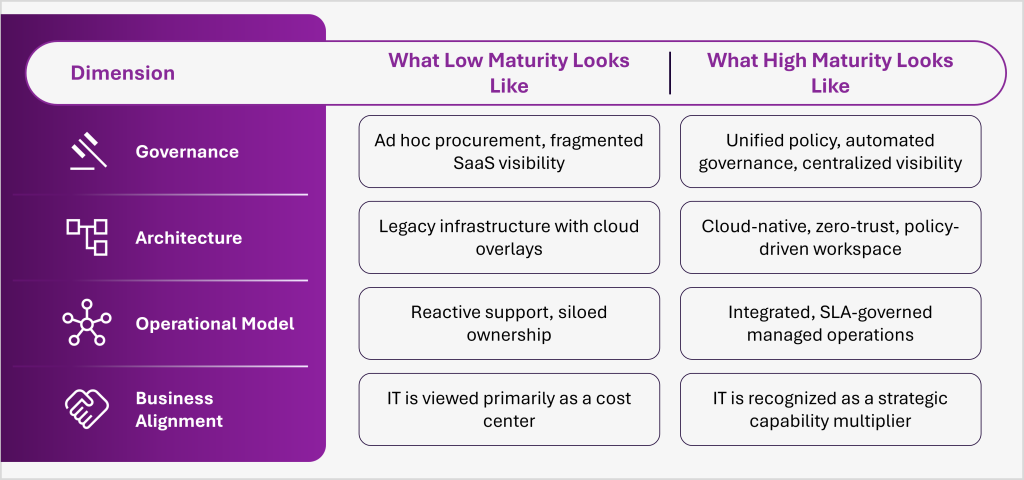
The strongest CIO IT modernization strategy addresses all four dimensions simultaneously because maturity rarely advances in isolation.
Enterprise IT faces a structural paradox. The teams responsible for closing the maturity gap are often the same teams that maintain the systems that created it.
Stability and transformation compete for the same resources. Performance metrics reward uptime, compliance, and operational consistency. Modernization requires experimentation, redesign, and organizational change.
At Anunta, we consistently find that organizations attempting to modernize while simultaneously managing day-to-day operations often slow progress on both fronts.
The most successful enterprises separate operational execution from strategic transformation. By leveraging managed endpoint services for enterprise, organizations create space for internal teams to focus on governance modernization, architecture redesign, and business alignment.
This is where Anunta’s expertise becomes particularly valuable. Through proven managed endpoint services and enterprise workspace modernization programs, we help organizations stabilize operational complexity while accelerating strategic transformation.
Organizations seeking an objective starting point can leverage Anunta’s IT Health Assessment, which evaluates workspace maturity across governance, architecture, operational model, and business alignment dimensions.
The enterprise IT maturity gap is no longer an IT problem. It is a board-level business risk.
Over the next three years, the organizations that move fastest will not necessarily be those spending the most on technology. They will be the organizations that convert technology investments into business capabilities with speed, consistency, and governance.
At Anunta, we believe the next generation of enterprise leaders will be defined by their ability to transform workspace complexity into business agility.
That transformation starts with understanding where the maturity gap exists and building a structured plan to close it.
Anunta’s workspace specialists will conduct a structured IT Health Assessment across all four maturity dimensions, helping you identify governance blind spots, modernization opportunities, and strategic priorities at no cost.
Explore Anunta’s IT Health Assessment and take the first step toward a future-ready enterprise workspace.
1. What is the difference between IT operational maturity and IT service maturity?
IT operational maturity evaluates how effectively IT executes governance, endpoint management, security, and operational processes. IT service maturity focuses primarily on ITSM processes. A comprehensive IT maturity assessment enterprise framework must evaluate both.
2. How does IT maturity affect enterprise digital transformation outcomes?
Low maturity slows transformation because fragmented architectures require additional integration, governance, and operational effort. High-maturity organizations execute modernization initiatives significantly faster and with lower operational risk.
3. What is IT architectural debt, and how does it differ from technical debt?
Technical debt arises from shortcuts taken in software development. IT architectural debt accumulates when infrastructure and governance models remain optimized for outdated business realities. It is one of the most common forms of workplace technology debt.
4. How should a CIO present the IT maturity gap to the board?
The most effective approach is to frame the maturity gap as a business velocity challenge. Quantify delays, governance inefficiencies, legacy maintenance costs, and missed opportunities rather than focusing exclusively on technical metrics.
5.What is the fastest way to close the enterprise IT maturity gap without disrupting operations?
Organizations achieve the fastest results by separating operational execution from strategic transformation. Managed operations models allow internal IT teams to focus on modernization initiatives while maintaining service continuity across the enterprise.