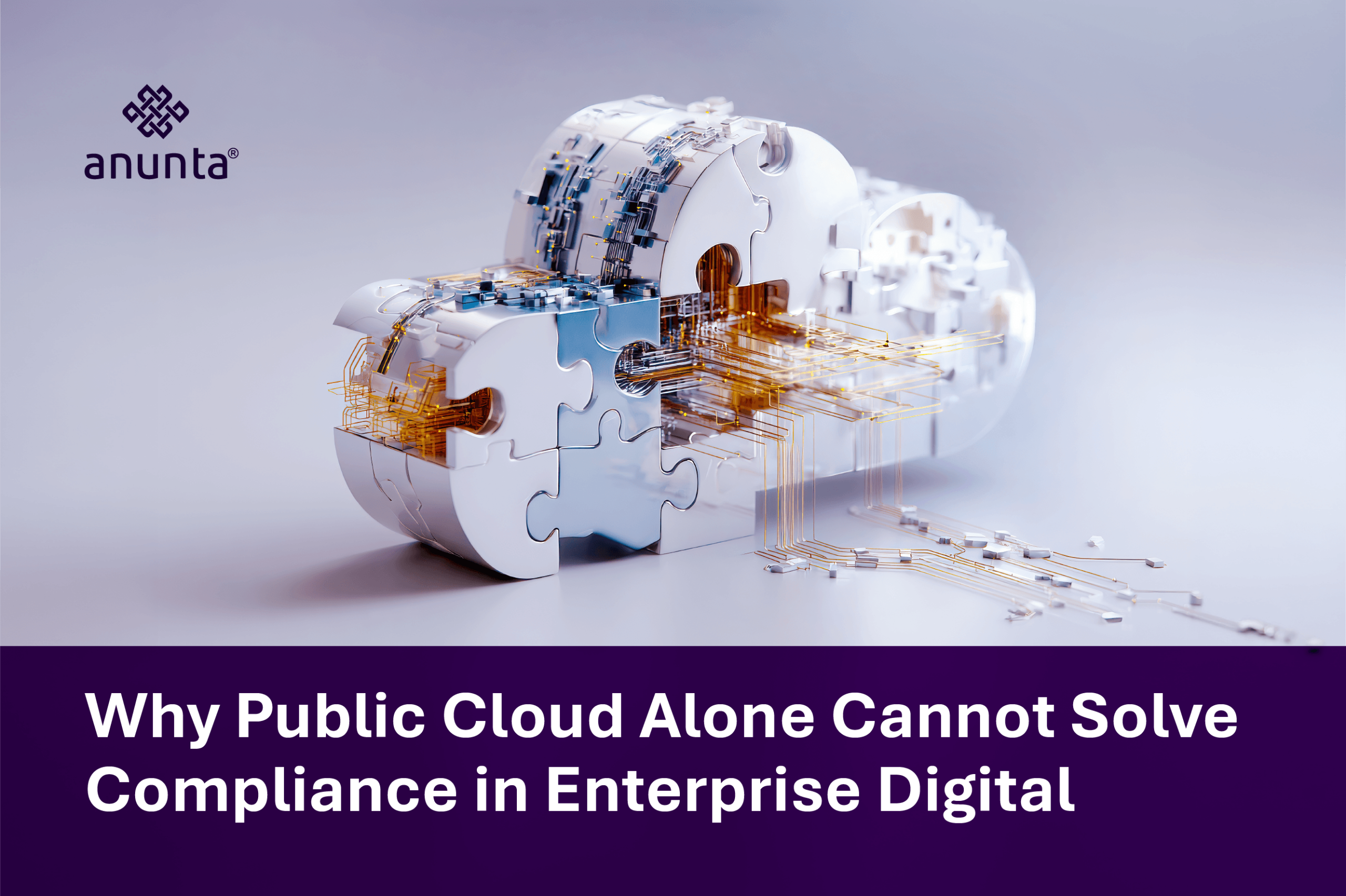
Cloud adoption has become the default direction for enterprise IT modernization.
For many organizations, moving workloads to the public cloud is seen as a direct step toward improved security, scalability, and compliance. The underlying assumption is simple:
If systems are hosted on a secure cloud platform, compliance requirements are inherently addressed.
This assumption is not entirely incorrect. But it is incomplete in a way that introduces risk.
Public cloud platforms provide a strong foundation for infrastructure security and availability. However, compliance is not defined by where workloads are hosted.
It is defined by how environments behave when users interact with systems and data.
That distinction is where most enterprise environments begin to break.
This gap is increasingly leading organizations to explore Sovereign Cloud approaches, where compliance is enforced through controlled, jurisdiction-aligned workspace environments rather than relying solely on infrastructure-level capabilities.
Public cloud platforms are designed to provide:
These capabilities are essential.
But compliance is not achieved solely through capability. It depends on how control is enforced across user environments.
In most enterprise setups, the cloud and workspace layers are treated separately.
Cloud is optimized. Workspaces are managed.
The gap between the two is where compliance risk emerges.
In cloud-first environments, several patterns consistently appear.
While infrastructure is secured, user environments vary widely.
Different devices, access methods, and locations introduce inconsistency in how policies are applied.
Without a standardized digital workspace, enforcement becomes uneven.
Cloud environments often span multiple services, regions, and configurations.
Access control, logging, and policy enforcement are distributed across these layers.
This fragmentation makes it difficult to enforce consistent governance.
Cloud platforms provide extensive telemetry.
Organizations can monitor activity, generate alerts, and analyze patterns.
However, visibility does not guarantee control.
Without a unified enforcement layer, organizations can observe risk without preventing it.
Hosting data in a specific region does not ensure compliance.
Data residency must be enforced during:
Without workspace-level control, data can move beyond intended boundaries.
These patterns highlight a fundamental limitation. Cloud provides capability, but not unified control. This is where Sovereign Cloud-based workspace models are emerging, bridging the gap between infrastructure and user-level enforcement.
The missing element in most cloud strategies is the digital workspace. Increasingly, this layer is being redefined through Sovereign Cloud-aligned workspace architectures, where control is centralized and enforced consistently.
The missing element in most cloud strategies is the digital workspace.
This is where:
In many organizations, this layer is:
As a result, compliance becomes dependent on multiple disconnected controls.
To address these challenges, organizations often invest in additional tools:
These tools provide important capabilities.
However, they operate within existing architectures.
They do not redefine how user environments are structured or controlled.
Without architectural alignment, tools increase visibility but do not eliminate fragmentation.
To achieve consistent compliance, control must be enforced at the point of interaction.
This requires a shift toward a workspace-centric model.
In this model:
In many enterprise environments, this model is operationalized through Sovereign Cloud frameworks that align infrastructure, workspace control, and compliance requirements into a single, enforceable structure.
This creates a unified control layer that bridges infrastructure and user behavior.
For technology leaders, this requires a change in approach.
Cloud should be viewed as a foundational layer, not a complete solution.
Compliance must be designed into how environments operate, not added as an afterthought.
This includes:
A few critical questions for enterprise teams:
If the answer to any of these is uncertain, cloud adoption alone has not solved the compliance challenge.
Public cloud has transformed how enterprises build and scale infrastructure.
It has not eliminated the need for architectural discipline.
Compliance today depends less on where workloads are hosted and more on how environments are controlled.
A Sovereign Cloud approach provides a structured way to achieve this alignment, ensuring that compliance is not dependent on fragmented controls but enforced consistently at the workspace level.
And that control begins at the digital workspace.