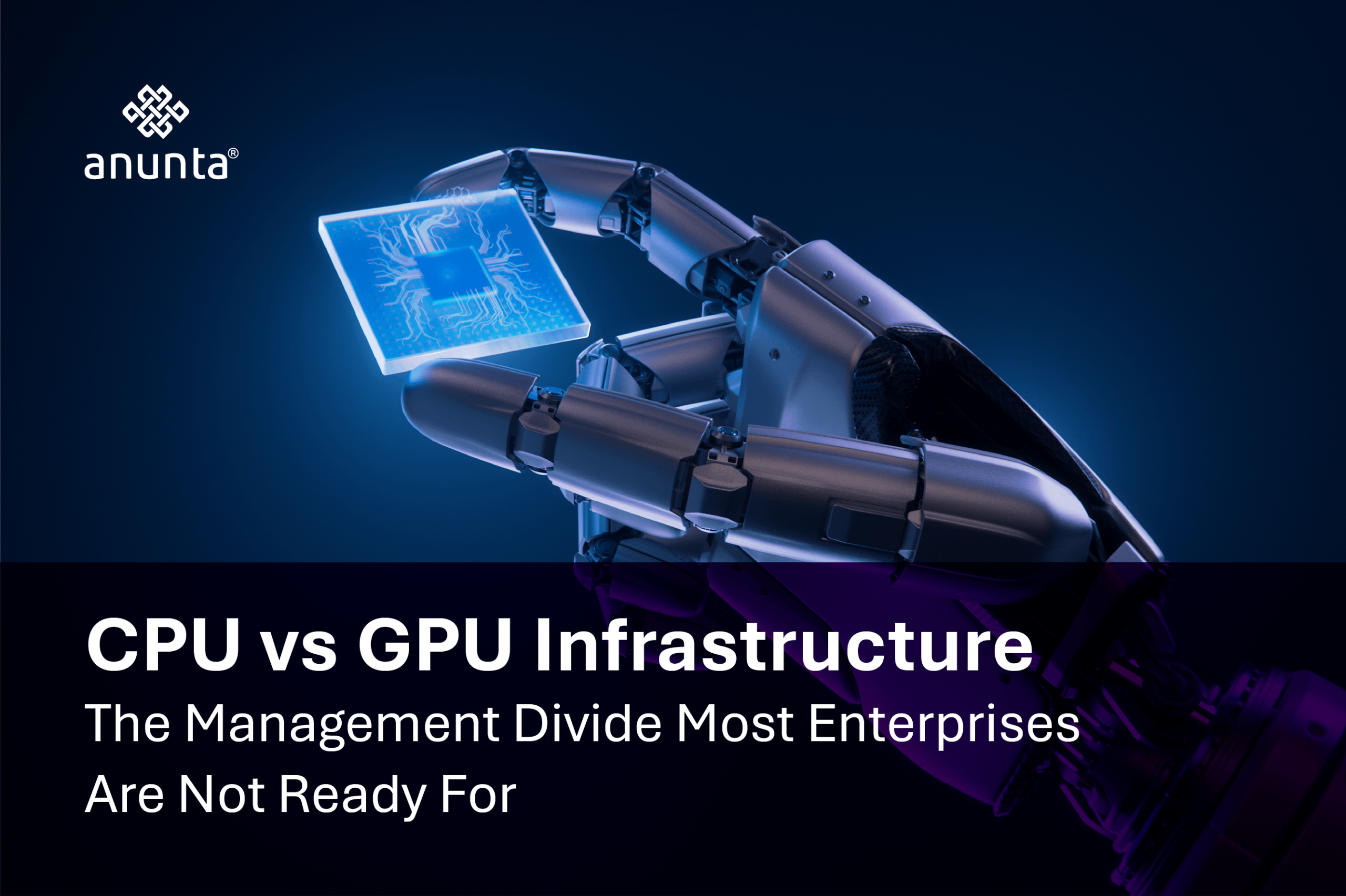
Enterprise interest in AI is growing exponentially, with large investments being made in GPU infrastructure to achieve speed, intelligence, and scale. However, with this growth comes an increasing chasm in operational functionality between the previous state of CPU infrastructure and what it will be in the future (AI and GPU-based).
CIOs across many sectors face similar challenges. Investment in GPUs is on the increase, but utilization is not at expected levels, operational costs are increasing without offsetting desired outcomes, and the root cause can’t be attributed to technology; it is the result of operational misalignment.
Anunta’s goal is to change this conversation by illustrating that the focus should not be on simply deploying GPUs, but rather on creating an effective and efficient operational model that supports GPU deployment from the data center through virtual desktop infrastructure through cloud computing, to manufacturing execution systems.
Traditional CPU infrastructure has a firm emphasis on predictability through a variety of structured workloads, such as ERP systems, databases, and transaction processing applications that provide consistent performance. In contrast, a GPU infrastructure is designed for high degrees of intensity and parallelism – workloads such as AI workload management, real-time inference, simulation workloads, and digital twins can all be processed simultaneously at scale.
Many organizations significantly miscalculated this transition.
A global BFSI organization implemented GPUs to accelerate their cloud-based fraud detection modelling; they anticipated performance gains but did not receive them. It was not on the basis of computing capacity but due to the fact that the fraud modelling was competing against legacy workloads in a CPU-based shared environment.
Using Anunta’s workload classification framework, the organization redesigned its infrastructure across the cloud and data centre layers to isolate and optimize its GPU workloads. Within a quarter, there was a dramatic reduction in model execution times and an increase in fraud detection accuracy.
The takeaway is that, while CPU infrastructure and GPU infrastructure are based on different principles of operation, if an organisation uses an inappropriate workload alignment to optimize the value of its respective infrastructure, it will not be able to leverage any actual value.
Many traditional infrastructure management enterprise operations continue to rely on obsolete CPU-related assumptions, such as monitoring tools, provisioning workflows, and incident response systems, all being designed for predictable and linear systems.
However, the introduction of GPU environments has brought about many new interdependencies that disrupt conventional CPU workloads, such as:
These are not minor changes and will change the operational structure of the data center.
An AI-driven manufacturing enterprise was conducting its manufacturing execution system using predictive analytics; however, it continued to have production simulation failures with its training workloads.
Anunta found that the gap across all of the Data Center and MES layers contained thermal variance and memory contention issues that were not visible to the current monitoring stack, and so it implemented an observability framework that provided the enterprise with real-time visibility across its GPU monitoring, thereby increasing system stability and providing the ability to conduct simulation cycles consistently.
When GPU infrastructure is observed only at a superficial level, it can appear chaotic; however, with an appropriate operational viewpoint, the GPU can be seen as a coherent, high-performance system.
In a distributed system, inefficiencies are costly and immediate when operating with a GPU.
Under-utilized GPU scheduling represents financial losses; unlike CPU infrastructure, which may have some ability to offset inefficiencies, in a distributed system with a GPU, inefficiencies manifest immediately.
For a global pharmaceutical company that was trying to scale AI-based drug discovery, its cloud-based GPU cluster was experiencing increased infrastructure expenses. Even after provisioning additional capacity, the performance continued to be erratic.
To address the issue, Anunta took a lifecycle approach to ownership versus an infrastructure addition approach. Anunta put its efforts toward orchestration and management rather than the addition of infrastructure.
Examples of how AI workloads were managed:
By taking these steps, Anunta not only reduced infrastructure costs but also achieved a lower training cycle time.
Use of GPU infrastructure when discussing infrastructure is complex and multifaceted, including accelerated computing, memory, interconnect, and workload efficiencies. Managing these types of infrastructures needs a deliberate plan of action and cannot be handled through automation alone.
The investment made into GPU infrastructure is undeniable; however, the insight into their performance is usually missing.
GPU monitoring must be performed at a very granular level:
In the case of a global engineering company using virtual desktops powered by GPUs as part of their VDI infrastructure, the users were experiencing latency spikes during the peak hours.
Anunta proceeded to trace the source of the lagging to both the VDI and data centre layers. There were no indications of GPU contention or bandwidth bottlenecks using any existing tools.
By developing observability metrics that covered both the infrastructure and the user experience layer, Anunta provided stable performance.
As a result, design teams indicated an increased level of productivity and shorter cycle time for iterations. Visibility on its own is not a technical enabler; it is also a business enabler.
The fragmented scale of GPU infrastructure is a result of a lack of structure. Sustainable growth means having the same direction within environments, teams, and tools.
The enterprise engagements of Anunta are anchored on four pillars.
An example of the value of accelerated computing solutions can be provided by a global automotive customer that relied on this model to create AI-based simulation results across all of its geographical plants. The timeframe to deliver simulated results has been greatly reduced while the efficiency of the infrastructure has improved in the process.
Therefore, operations are now seen as part of a strategic lever.
The change from CPU infrastructure to GPU infrastructure is much more than upgrading your technology; it’s about changing how people operate. Today’s environments include:
Enterprises that successfully build reliable/highly available GPU infrastructures do so by recognising the following fundamental operational truth: CPU-based and GPU-based infrastructures are completely different operational disciplines.
Anunta solves this problem through lifecycle ownership, from the initial design of a system on Day 0 and continuing through to Day 2 operations. The emphasis is always on combining your infrastructure, workload, and operations into a unified model.
In one enterprise-wide transformation, Anunta delivered the complete integration of GPU-based systems into Cloud VDI Migration pipelines, resulting in not only increased performance but also much faster product development cycles and measurable business acceleration!
The divide between CPU vs GPU infrastructure is defining the next era of enterprise computing.
Organizations that delay alignment face:
Organizations that act decisively achieve:
NVIDIA may power the hardware, but outcomes are shaped by how effectively that infrastructure is managed.
Anunta transforms this complexity into clarity. By embedding operations into every layer of infrastructure, enterprises move from fragmented execution to outcome-driven performance. Anunta has deep expertise with AI Data Center Infrastructure, Observability of AI Workloads, and workload orchestration, which helps move enterprises from operating in a fragmented fashion to a controlled, outcome-oriented fashion.
The future will not be won by those who adopt GPUs first. It will be won by those who manage them best.
To get the best solutions for your specific needs, talk to an Anunta expert today.