Enterprises now expect Desktop as a Service to deliver a secure, flexible desktop from day one, with minimal internal overhead. That expectation is only half correct because the platform itself rarely fails once deployed. The operational model built around it determines whether the investment yields real productivity, reduced risk, and a measurable return, or becomes a support burden nobody budgeted for.
Gartner forecasts that worldwide DaaS spending will grow from $4.3 billion in 2025 to $6.0 billion by 2029, a 7.9% compound annual growth rate, according to the 2025 Gartner Magic Quadrant for Desktop as a Service. That is strong evidence that adoption intent continues to climb even as delivery gaps persist across the industry. Yet the growth curve masks a harder truth: enterprises keep stalling well past the pilot phase, because the gap between what they purchased and what their teams can actually operate goes largely unaddressed at go-live.
This article breaks down where that gap opens, what it costs an organization in practice, and the specific operational moves that close it.
Adoption rarely fails at the proof-of-concept stage. It stalls months later, once security concerns, integration gaps, and performance issues accumulate faster than an internal IT team can resolve them.
Gartner’s Peer Community survey on DaaS adoption names the barriers directly. The most frequently cited challenges among adopters are:
More than half of these barriers are not technical limitations of the platform itself. They are operational and organizational, which means they respond to operational fixes rather than platform swaps.
The root cause sharpens further when the same survey is read against adoption intent. According to Gartner, 54% of surveyed organizations adopted DaaS specifically because internal IT lacked the skills to manage a VDI solution. That is the central paradox. The same skills gap that justified the move to DaaS often persists after go-live, and without an operational layer built to absorb it, the DaaS environment inherits the exact support burden the organization was trying to escape.
The business consequence extends well beyond help desk tickets. Unmanaged DaaS environments create cascading risk: unpredictable performance erodes user confidence, delayed resolution escalates to executives, uncontrolled cost growth surprises finance, and compliance gaps surface quietly, usually at audit time.
Three failure patterns emerge consistently once a DaaS environment scales beyond the pilot.
Performance Degradation Compounds Quickly
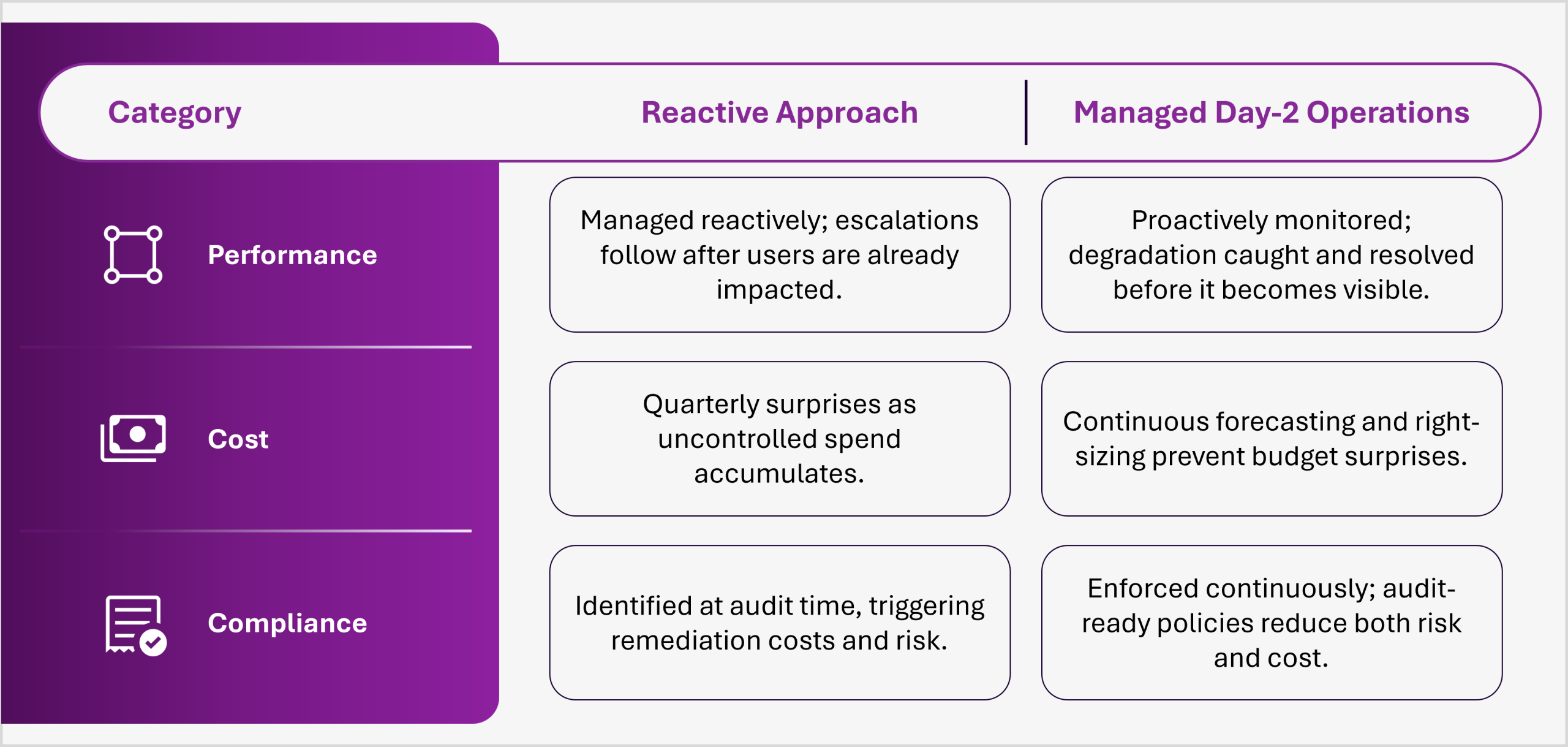
Login times stretch beyond user tolerance. Applications load inconsistently. Desktop responsiveness turns erratic. Each symptom cascades into user frustration and escalated tickets, and once this happens across dozens or hundreds of users, IT shifts from proactive management into constant firefighting.
Cost Visibility Breaks Down
Oversized instances run idle. Scaling decisions get made reactively, under pressure. Without shared visibility between IT and finance, cost trends surface as quarterly surprises rather than early forecasts, and by then the environment has become too expensive to right-size cleanly.
Compliance Risk Accumulates Silently
Desktop lifecycle management turns inconsistent. Patch cycles slip. Access controls become difficult to enforce across a dispersed environment. Audit time reveals gaps in trails, provisioning oversight, and controls that should have been centralized from the start.
Reducing Performance Variability Across the Workforce
Performance reliability translates directly into productivity. When desktops respond predictably, users stay focused on their work instead of fighting their infrastructure.
Making End-User Experience Predictable at Scale
Poor end-user experience, cited by 17% of adopters as a barrier per Gartner, is almost always an operational symptom wearing a platform problem’s face. Slow logons, sluggish applications, and desktop bloat are operational failures, not DaaS limitations. Managed oversight tightens profile management, maintains consistent patching cycles, and coordinates endpoint synchronization to keep the user experience predictable rather than erratic.
Governing Cost Growth Before It Becomes a Budget Surprise
Unmanaged environments accumulate overruns through oversized instances, idle capacity, and reactive scaling. The 2025 Gartner Magic Quadrant for Desktop as a Service notes that the total cost of ownership for DaaS, particularly when paired with thin-client endpoints, is now lower than that of a laptop PC for many use cases, but only when operations are optimized continuously. Operational governance gives IT and finance shared, advanced visibility into spend trends before they become quarterly surprises.
A mature Day-2 operating model changes outcomes that reach past the IT department. Reliable desktop performance lets distributed teams serve customers consistently. Predictable cost and performance give executives the confidence to scale the workforce without a corresponding spike in support risk. Centralized lifecycle management and compliance controls reduce regulatory exposure before it becomes a finding.
Gartner projects that by 2027, virtual desktops will be financially viable for 95% of the workforce, up from 40% in 2019. That shift is not happening because the underlying technology has changed. It is happening because organizations are investing in Day-2 operational maturity around a platform that was already sound.
Three moves determine whether a DaaS environment stabilizes or continues to stall.
Audit where adoption is actually stalling. Security concerns, performance issues, cost growth, and user experience degradation each demand a different operational response. Use the failure-mode categories above as a diagnostic checklist, and identify not just what is broken but which operational discipline is missing. Then define the next action for each gap.
Diagnose whether the gap is a skills gap, a staffing gap, or a tooling gap. A skills gap calls for training and operational frameworks. A staffing gap calls for outsourcing or hiring. A tooling gap calls for investment in monitoring and automation. Conflating the three produces fixes that miss the actual constraint. Then assign ownership and set the next action accordingly.
Replace ad hoc firefighting with an ongoing operational model built on defined SLAs. Day-2 operations are where DaaS either becomes a strategic asset or a perpetual liability. Start by formalizing the operating model, then move to steady governance and support.
The contrast is clear in the same survey data cited earlier. Organizations that adopted DaaS because of internal VDI skills gaps, 54% of respondents, but never addressed that gap operationally, continue facing the same barriers well past go-live. Those who invest in Day-2 support governance move from struggling to scale to scaling with confidence.
Reactive vs. Managed Day-2 Operations
Anunta’s case study, Powering High Application Availability for an Indian Bank Through VDI, shows what closing the Day-2 gap looks like at enterprise scale. Anunta designed a custom VDI environment spanning Treasury operations, remote branches, loan processing centers, and contact centers, each with different performance, compliance, and bandwidth requirements.
The measured outcomes are specific to this deployment, as noted in the case study above. The bank achieved 99.97% application availability, an 80% reduction in incident-to-user ratio, and a 54% reduction in mean time to response (MTTR), with smart monitoring proactively resolving 90% of issues before they escalated. Software deployment time dropped by over 90%, power consumption fell 85% compared to the bank’s traditional desktop setup, and when the bank acquired another institution, Anunta integrated the new Treasury function into the environment within 24 hours.
These results reflect a specific deployment and are not guaranteed in every environment. They illustrate what a structured Day-2 operating model, applied consistently across a regulated, performance-sensitive workforce, can produce.
Sustainable DaaS is an operations discipline built after go-live, not a decision finalized before it. Enterprises that reduce support costs and scale their workforce with confidence are the ones treating Day-2 operations as the primary success factor, not an afterthought. To close the gap, keep Day-2 operations active, measurable, and accountable after rollout.
Anunta’s Day-2 operational model is built specifically to close this gap. We monitor performance continuously, manage the lifecycle and compliance proactively, govern costs to prevent surprises, and provide tiered support, so that issues are resolved at the right level rather than escalating unnecessarily.
If your DaaS environment is stalling or delivering inconsistently, a platform change is rarely the fix. An operational review usually is. Talk to Anunta’s Day-2 operations team to review your current environment, or explore our DaaS and VDI solutions to see how the model works in practice. Then decide whether to move into review or evaluation.
1. Why does DaaS adoption stall after the initial rollout?
DaaS adoption rarely fails at the pilot stage. It stalls months later, once security concerns, integration gaps, performance issues, and end-user complaints accumulate faster than an internal team can resolve them. The platform itself is typically sound; the operational layer around it is insufficient. A managed Day-2 support model absorbs that load through continuous monitoring, proactive issue prevention, and tiered support, so the rollout scales as originally planned.
2. What typically causes DaaS performance issues, and how are they fixed?
Performance issues usually trace back to undersized resource allocation, network latency, profile bloat, or image misconfiguration rather than platform limitations. Fixing them requires continuous monitoring to catch degradation early, ongoing capacity right-sizing instead of one-time tuning at go-live, and proactive maintenance of desktop images and user profiles. Managed DaaS support handles all three continuously, not only when problems escalate.
3. How can enterprises control DaaS cost overruns?
Cost overruns typically come from oversized instances, idle capacity left running, and reactive scaling decisions made under pressure. Ongoing cost governance with shared visibility for both IT and finance catches these patterns before they become a quarterly budget surprise. Managed DaaS support provides this governance through continuous monitoring, proactive right-sizing recommendations, and advanced forecasting, enabling both teams to plan strategically.
4. What does managed Day-2 DaaS support typically include?
Managed Day-2 DaaS support typically covers root cause diagnosis for performance and login issues, coordination with underlying cloud and platform vendors, patch and image lifecycle management, tiered support so incidents are resolved at the right level, compliance oversight, and cost governance. The goal is to make operational issues visible and resolved before they affect users or budgets.
5. Is managed DaaS operational support available across multiple regions?
Yes. Enterprises operating across multiple geographies can access managed DaaS operational support with regional points of contact for implementation, troubleshooting, performance optimization, and compliance management, so a distributed workforce receives a consistent level of operational governance regardless of location.