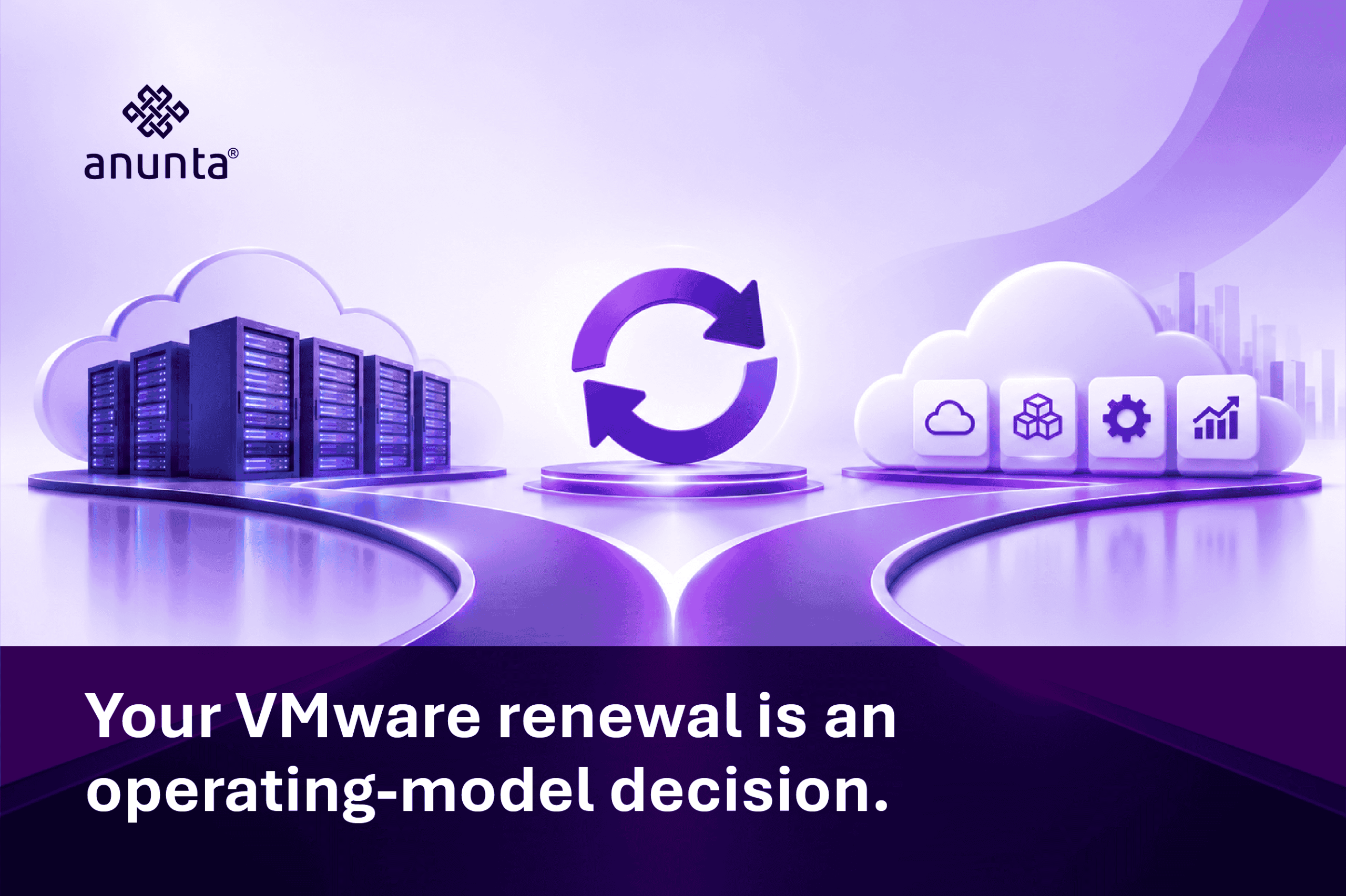
In short: If your VMware renewal is due, treat the quote as a decision point. Broadcom’s per-core subscriptions have pushed costs sharply higher, and vSphere 8 support ends in October 2027. Compare four paths: renew, move to Nutanix on-premises, lift to Nutanix Cloud Clusters (NC2) on Azure or AWS, or go hybrid. Start with a workload assessment, because the right path depends on what each application needs.
A VMware renewal decision should start before the quote arrives. That deadline is your term end date or the end of vSphere 8 support in October 2027, whichever comes first. Broadcom completed its acquisition of VMware in November 2023, so three-year agreements signed soon after the deal closed are reaching renewal in late 2026 and 2027. Those renewals are priced under Broadcom’s per-core subscription model, which can put the new quote far above the price of the previous term. That gap turns the renewal into a planning decision as well as a purchasing one.
Many teams handle the renewal as a procurement task, but it’s really just forcing the bigger question: which platform and operating model should run your infrastructure over the next five years?
IT leaders now face rising costs if they stay and real risk if they move. Broadcom has changed what VMware costs, how you migrate off it, and where you buy it.

The result: In Virtified’s survey of 450 IT professionals across 14 countries, 48% said they plan to reduce their VMware footprint by 2028, primarily due to Broadcom’s licensing changes. Vendor research from CloudBolt points the same way, with 86% of 302 North American IT decision-makers reducing their VMware use and only 4% having fully replaced it.
The hard part of leaving VMware is deciding which workloads to move, where each should go, in what order, and who will run them afterward. Each of those decisions depends on what surrounds the virtual machine: the NSX network policies, the storage layout, the backup jobs, and the monitoring the team has built around vSphere over the years. A workload that looks simple on its own often depends on a database, a license server, or a firewall rule that must move first, so the migration order matters as much as the destination.

In our experience, if you get that wrong, you trade a licensing problem for an outage, a stalled project, or an overstretched team. A sound plan therefore covers the operating model as well as the platform, including who assesses, migrates, and runs each workload after go-live.
Speaking at a Gartner conference in Sydney in May 2026, analyst Paul Delory cautioned that leaving VMware adds complexity. He also said that HCI vendors other than Nutanix have weak migration tools, which leave customers building their own migration automation, as The Register reported.
As migration is one of the core services we offer, we can provide you with a tried-and-tested approach across the lifecycle. And we’re partnering with Nutanix. That means our partnership with Nutanix goes beyond resale:
Many VMware estates also host virtual desktops. Anunta’s virtual desktop infrastructure (VDI) expertise across Omnissa Horizon, Azure Virtual Desktop, Citrix, and Accops lets you plan for desktop users to be included in the same migration as the servers they depend on.
The outcome is one accountable partner, from the first assessment to day-two operations.
Each of the four realistic paths fits a different kind of estate.
| Path | Best when |
|---|---|
| Renew VMware | You need time to plan a move. |
| Nutanix on-premises | You want control, predictable costs, and data kept in-country. |
| NC2 on Azure or AWS | You are exiting a data center or need to scale fast. |
| Hybrid, in phases | Your estate is mixed, or you need DR without a second site. |
To help hone in on your situation, start by answering these four questions:
Download the VMware Renewal: 4 Paths Comparison Guide for a side-by-side comparison.
Can Nutanix run in the public cloud? Yes. Nutanix Cloud Clusters (NC2) run the Nutanix stack on Azure and AWS, so applications move without being re-architected.
What does Anunta add to Nutanix? End-to-end delivery: assessment, migration, deployment, modernization, and ongoing managed operations, with local support across APAC, India, and MENA.
Start with an assessment, not a quote. Anunta will map your estate, compare your paths, plan a low-risk move, and then run the platform for you.