Every enterprise operating in India now processes personal data through thousands of laptops, virtual desktops, and mobile devices used by employees, contractors, and offshore teams. The Digital Personal Data Protection Act, 2023, sets out how organizations must protect that data. DPDP Act compliance for enterprises is now an ongoing operational question rather than a future deadline.
The Act places obligations on the organization as a Data Fiduciary rather than on individual devices. Every laptop, virtual desktop, and mobile endpoint still carries part of those obligations through access control, data protection, and incident response.
IT operations and security heads in banking, healthcare, ITES, and manufacturing no longer care whether the organization has read the Act; it is whether it can show, endpoint by endpoint, where personal data is accessed and governed. That is DPDP readiness, an operating discipline, not a document to file away.
The DPDP Act places enforceable obligations on Data Fiduciaries—organizations that determine why and how personal data is processed. The Act and Rules define the obligations, how enterprises implement them across endpoints, desktops, and other environments, and penalize weak implementations heavily.
The Act provides for penalties of up to ₹250 crore when an organization fails to implement reasonable security safeguards under Section 8(5). Significant Data Fiduciaries carry that same exposure along with a heavier set of duties.
Significant Data Fiduciaries face additional requirements, including an India-based Data Protection Officer, annual Data Protection Impact Assessments, and annual independent audits. Meeting these obligations requires visibility into where personal data is stored, accessed, and processed across the enterprise environment.
Section 16 of the DPDP Act allows the Central Government to restrict transfers of personal data to specific countries or territories, and other Indian laws may impose stricter limits. Enterprises with distributed and remote workforces need to track where personal data is accessed, processed, and stored.
The Ministry of Electronics and Information Technology notified the DPDP Rules, 2025, in November 2025. The Rules phase in key obligations in stages, and most take effect in May 2027. That window gives enterprises time to build controls, and most of those controls run on endpoints.
Enterprises meet DPDP obligations through controls running on endpoints, where employees open, copy, and share personal data every day. Endpoints, not core servers, are usually where cyberattacks start. In a survey of senior business, technology, and security executives in India, 28% said the damage from cyberattacks over the past three years ranged from one to nine million US dollars.
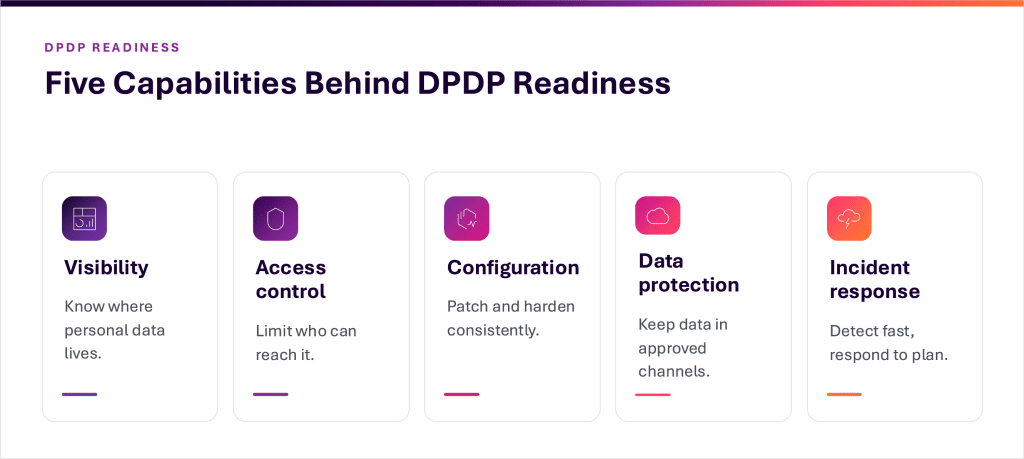
Five capabilities carry DPDP obligations onto endpoints: visibility, access control, configuration consistency, data protection, and incident response. Each capability answers a specific requirement in the Act or the Rules.
An organization cannot govern what it cannot see. A centralized inventory should show which devices access personal data, where that data is accessed or processed, and what categories are involved.
Visibility must be followed by control. Role-based, least-privilege access limits who can view, copy, or export personal data based on business need.
Inconsistent patching and hardening can leave gaps across regions. Centralized management helps apply and audit consistent security baselines across the fleet.
DLP controls can restrict unauthorized copying, printing, or transfer of sensitive files. A centralized digital workspace can also keep data within controlled data centers or cloud environments rather than on local drives.
The DPDP Rules prescribe breach-notification requirements for the Board and affected individuals. Continuous monitoring and a rehearsed response process help organizations detect and respond to incidents without having to start from scratch.
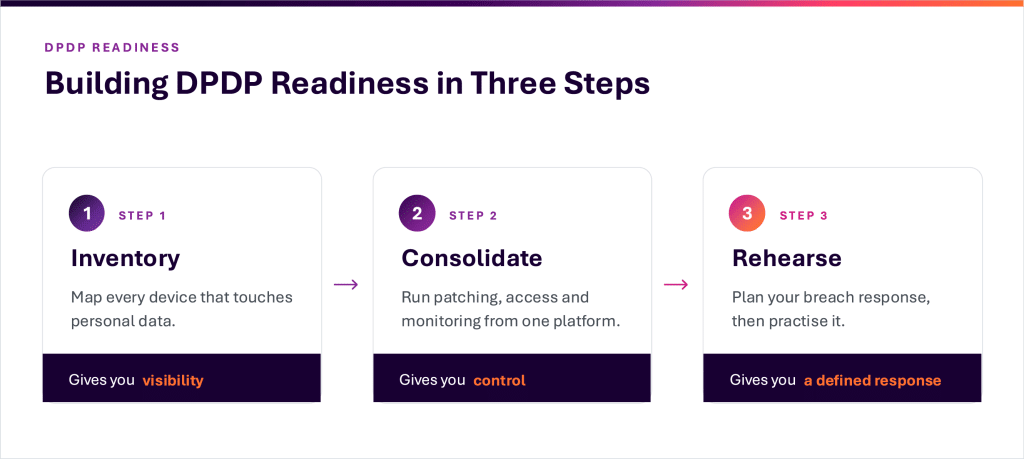
The five capabilities reduce to three steps, and each step depends on the one before it:
In May 2027, most of the DPDP obligations take effect. Enterprises that start endpoint inventory now can show the Data Protection Board where personal data resides as soon as the Board asks, rather than assembling an answer during the incident.
Anunta helps enterprises consolidate device visibility, enforce consistent access and configuration policies, and build breach-ready playbooks. The work covers managed desktops, virtual desktops, and mobile endpoints through a centralized digital workspace model.
For one global healthcare enterprise, a read-only virtual desktop architecture brought ransomware-hit devices back into service within minutes, with all operational data intact.
Visit our managed endpoint services page to see how a governed digital workspace supports DPDP readiness for your environment.
Q: What is the DPDP Act for businesses in simple terms?
A: The Digital Personal Data Protection Act, 2023, is India’s law governing how organizations, called Data Fiduciaries, collect, process, and protect personal data. It requires clear consent, defined purposes for data use, and accountability for safeguarding that data. Still, it regulates the organization’s practices rather than certifying any individual device or system as compliant on its own.
Q: What is the DPDP Rules 2025 compliance timeline?
A: The Ministry of Electronics and Information Technology notified the DPDP Rules in November 2025, and enforcement is rolling out in phases, with the final substantive provisions coming into force in May 2027. Enterprises are expected to use this window to complete gap assessments, strengthen governance, and build the operational capabilities on which DPDP readiness depends.
Q: What is the DPDP Act penalty for a data breach?
A: Penalties under the Schedule to the Act can reach up to ₹250 crore. The highest tier applies to a failure to implement reasonable security safeguards, which makes endpoint governance a financial priority.
Q: What are significant data fiduciary obligations under the Act?
A: Significant Data Fiduciaries are organizations that the Central Government notifies under section 10 of the Act, based on factors that include the volume and sensitivity of the personal data they process. They must appoint an India-based Data Protection Officer, conduct annual Data Protection Impact Assessments, and undergo annual independent data audits. Meeting these obligations depends on having accurate, endpoint-level visibility of where personal data is stored and processed.
Q: What does an endpoint security compliance checklist look like for DPDP readiness?
A: A practical checklist covers the five operational capabilities DPDP readiness rests on: a live device inventory mapped to data category, role-based access control, consistent patching and configuration across regions, data loss prevention at the endpoint, and a rehearsed breach notification playbook. A centralized digital workspace typically brings these capabilities together on a single, governed platform rather than leaving each one to a separate tool.