CIOs do not need ideology. They need a decision framework.
As enterprises rethink sovereign-ready infrastructure for the AI era, the challenge is no longer whether hybrid environments will exist. The challenge is how to distribute workloads across them intelligently.
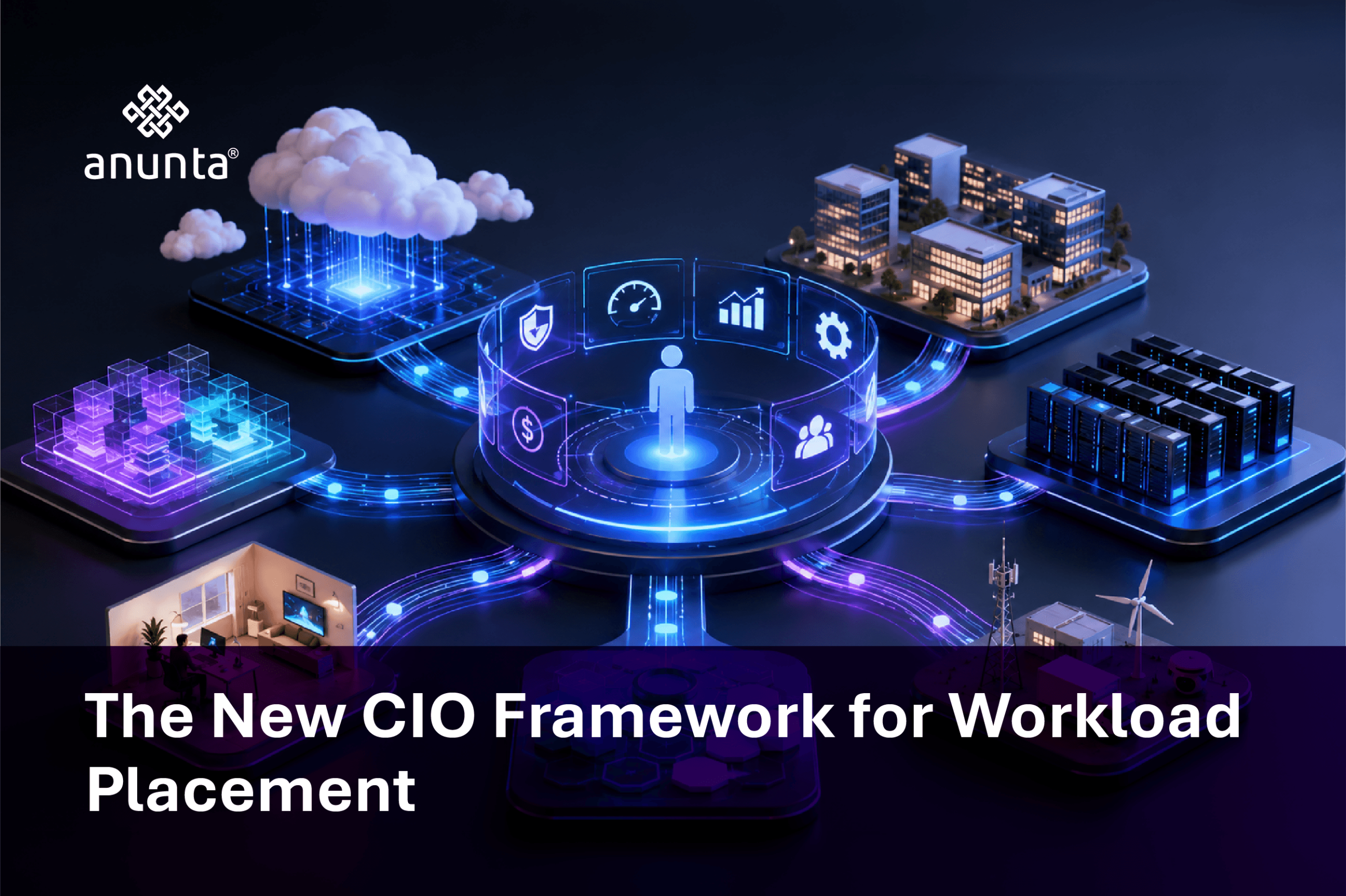
At Anunta, enterprises are increasingly adopting what we call a Workload Sovereignty Model, a practical approach for evaluating where workloads should operate based on business, governance, and operational realities.
The framework evaluates workloads across three dimensions:
Modernization is no longer measured by migration scale. It is measured by workload placement intelligence.
In practice, workloads rarely move in isolation.
Dependencies across APIs, data pipelines, identity systems, observability layers, and operational tooling often determine migration feasibility more than theoretical scoring models.
This is why many enterprises discover that hybrid operating models are not transitional states. They are the long-term architecture.
Workloads increasingly moving toward localized or hybrid infrastructure include:
Workloads continuing to benefit from public cloud include:
The question is no longer “Should we move to the cloud?”
The question is:
“Which workloads justify permanent dependence on centralized cloud infrastructure?”
One of the most important architectural shifts emerging in enterprise infrastructure is the separation between the control plane and the data plane.
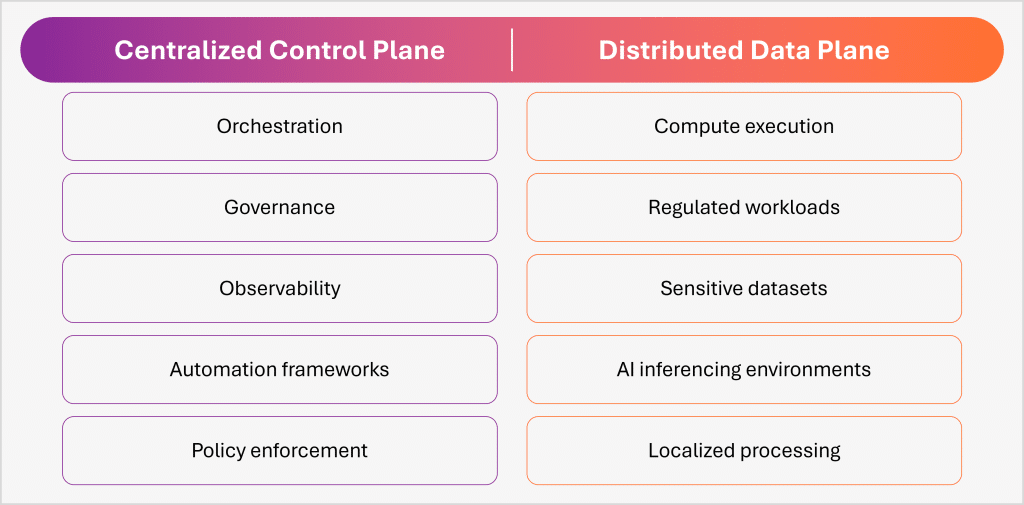
The future of infrastructure is not centralized compute. It is centralized governance with distributed execution.
That is what makes modern hybrid operating models sustainable.
Platforms such as Microsoft Azure Local are becoming strategically important not as replacements for cloud modernization, but as enablers of intelligent workload distribution.
Azure Local allows enterprises to maintain:
while modernizing infrastructure environments inside enterprise-controlled operational boundaries.
One of the biggest barriers to adopting sovereign-ready infrastructure is not architecture but operational complexity at scale. As enterprises expand distributed infrastructure environments across branches, plants, data centers, and hybrid operational zones, orchestration consistency becomes critical.
DesktopReady acts as Anunta’s orchestration and operational acceleration platform for sovereign-ready infrastructure environments across cloud, hybrid, and on-prem architectures. The platform supports:
DesktopReady is not positioned as a replacement for native infrastructure tooling. Instead, it simplifies the operationalization of distributed sovereign infrastructure environments by reducing deployment complexity, accelerating rollout consistency, and standardizing governance operations.
DesktopReady accelerates Azure Local task fulfillment by replacing native-tool complexity and manual handoffs with orchestrated, repeatable workflows that reduce delivery timelines from days to hours.
This enables enterprises to improve:
Pre-validated operational templates further allow enterprises to deploy rapidly:
without requiring highly specialized engineering skill sets.
Hybrid infrastructure is increasingly becoming the default enterprise operating model. Modern enterprises increasingly require:
Enterprises are no longer simply operating infrastructure. They are increasingly becoming internal sovereign infrastructure providers.
Evaluate whether your infrastructure environment is prepared for:
Connect with Anunta for a Sovereign Readiness Advisory Session designed for regulated enterprise environments.