For nearly a decade, “cloud-first” was the rule, not the question. Today, that conversation is changing. Quietly, but materially.
Across banks, financial institutions, insurance providers, healthcare organizations, manufacturers, and public-sector enterprises, CIOs are beginning to ask a more strategic question:
“What should stay in the cloud and what no longer makes sense to keep there?”
This shift is not about reversing modernization. It is about regaining architectural balance.
As enterprises rethink sovereign-ready infrastructure for the AI era, the challenge is no longer whether hybrid environments will exist. The challenge is how to distribute workloads across them intelligently.
That is where the next phase of enterprise modernization begins.
Not with migration velocity. But with workload sovereignty.
Cloud migration enabled enterprises to achieve scalability, elasticity, operational agility, faster experimentation, and accelerated innovation. In many cases, those outcomes were real and transformational.
But the operating realities of 2026 are forcing CIOs to confront a harder architectural truth.
The infrastructure debate is no longer about whether cloud works. It is about whether every workload belongs there indefinitely.
Three pressures are driving that reassessment:
The future is no longer cloud-first or on-prem-first. It is workload-first.
The next phase of modernization is not about moving everything back on premises. Nor is it about abandoning cloud innovation.
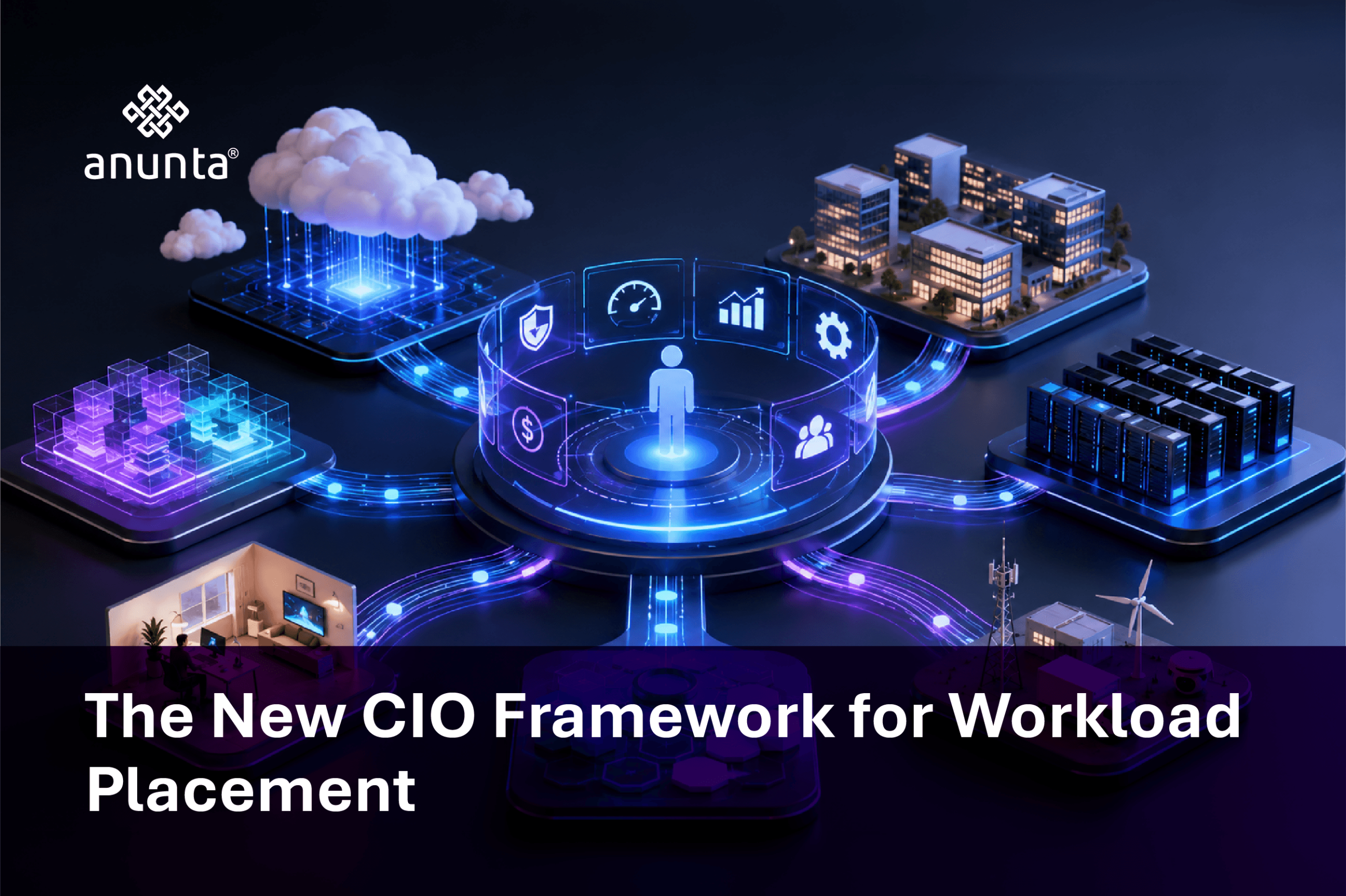
It is about designing infrastructure environments where workloads are placed according to governance requirements, latency sensitivity, AI locality, cost predictability, and resilience objectives.
Workload sovereignty is the ability to place workloads in the operational environment that best aligns with business continuity, governance obligations, performance requirements, and operational control.
The organizations that treat infrastructure as a governance and operational control layer, not merely a hosting environment, will define the next decade of enterprise modernization. That requires CIOs to move beyond simplistic “cloud versus on-prem” thinking and toward intelligent workload segmentation.
The cloud-first era unintentionally centralized enterprise workloads into a limited number of hyperscaler regions and operational ecosystems.
While this accelerated modernization, it also introduced new operational concentration risks. Today, CIOs are increasingly evaluating:
The next wave of infrastructure modernization may be driven less by scalability and more by governance, jurisdiction, and AI control.
India’s enterprise environment may accelerate workload sovereignty adoption faster than many global markets because of three converging realities:
As a result, Indian enterprises may become early adopters of sovereign hybrid operating architectures not because of nostalgia for traditional infrastructure, but because governance, economics, and resilience increasingly demand it.
Cloud-first was never meant to mean cloud-forever.
The next generation of enterprise infrastructure will not be defined by public cloud alone or private infrastructure alone. It will be defined by workload sovereignty, governance-led architecture, distributed resilience, intelligent workload placement, and AI-ready operational control.
The organizations that treat infrastructure as a governance and operational control layer, not merely a hosting environment, will define the next decade of enterprise modernization.
The uncomfortable question many CIOs now face is no longer:
“How much have we migrated?”
It is:
“Which workloads still belong where they are and which remain there purely out of habit?”