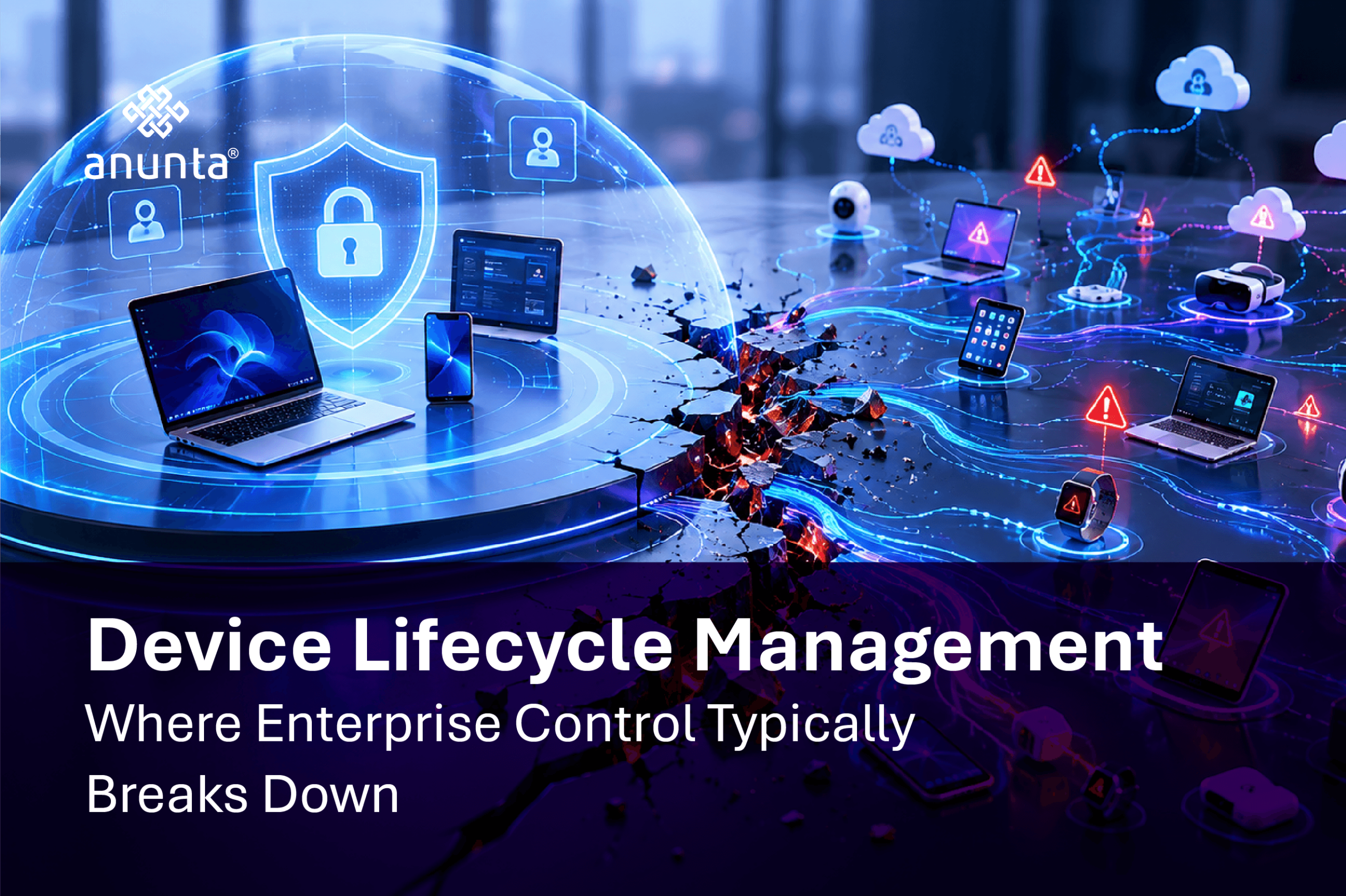
When an employee leaves, a laptop disappears; a contractor’s device goes unregistered. Audits uncover unknown endpoints.
The key takeaway: Minor lapses can escalate. Early detection and intervention are essential for effective control.
Modern enterprises manage thousands of endpoints across hybrid work settings, distributed teams, and multiple countries. Many organizations treat Device Lifecycle Management as a fragmented checklist rather than as ongoing governance.
Key takeaway: Device management gaps lead to poor visibility, compliance risks, and operational threats. Organizations must proactively address these gaps.
Enterprise Device Management now requires not only hardware provisioning but also lifecycle control through retirement, ensuring continuous asset visibility.
Continuity is the issue; not the device count.
Takeaway: Regaining control over interruption points is crucial to prevent costly governance incidents.
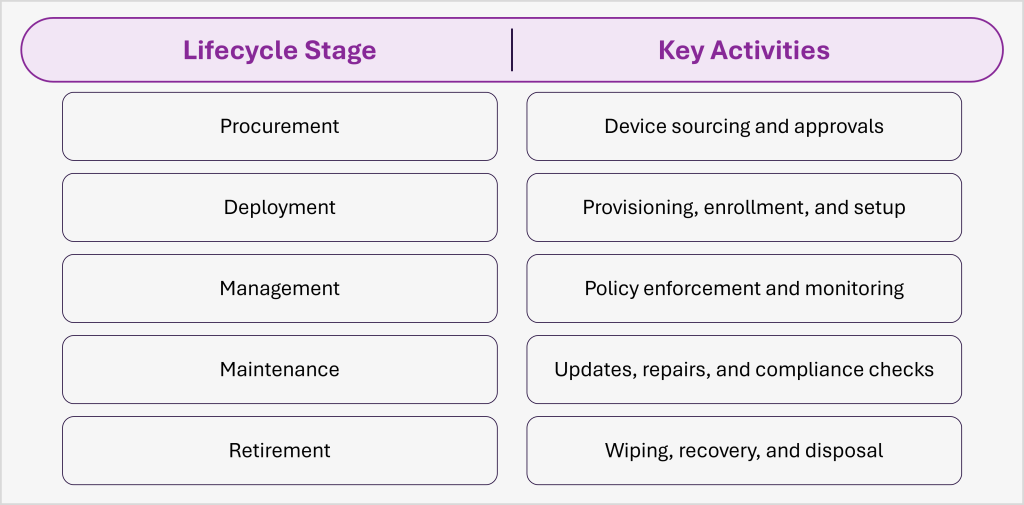
Device Lifecycle Management is the process of managing enterprise devices throughout their entire operational journey.
Every device moves through five key stages:
 Most enterprises struggle because lifecycle processes lack ecosystem integration. Remote work, fragmented tools, BYOD, contractor access, or silos widen governance blind spots.
Procurement may buy devices that are never fully enrolled. A secure laptop today may become noncompliant in six months. Retired endpoints may still hold data.
Here is where Device Management unravels.
Organizations with more mature governance throughout their lifecycle rely on unified digital workspace strategies to achieve visibility, automate workflows, and ensure policy continuity across every device touchpoint. Anunta provides scalable endpoint governance and managed digital workspace experience to provide this exact type of support for enterprises.
Before employees start working, one of the most significant gaps in endpoint device management is already present.
Which is:
An enterprise purchases thousands of laptops for employees working from home; however, the machines will be delivered to their homes. Some employees may set up their laptops right away, while others may delay their enrollment. A couple of other laptops will never be enrolled in an MDM environment.
Procurement records every purchase, but IT cannot see or track all devices.
This disconnect hinders asset tracking, as phantom assets accumulate outside governance.
Without automated enrollment, IT loses:
As organizations grow, this problem intensifies.
A strong example is Anunta’s rapid onboarding transformation for a global steel manufacturing major, where Workspace ONE UEM helped reduce provisioning time from 2 days to 4 hours while improving endpoint visibility, onboarding efficiency, and compliance consistency for 8,000 users.
Modern organizations are prioritizing four major areas for managing their endpoint devices:
Without an endpoint governance framework, devices become operational liabilities.
Shadow IT is more than just unauthorized software use. Unmanaged devices, such as contractor equipment and personal devices used for work, are now considered Shadow IT. Enterprises often lack visibility into the use of these devices; as a result, their unmanaged status creates blind spots in Enterprise Device Management solutions that pose significant risk.
There are many reasons for this unmanaged use of devices, including:
Unmanaged endpoints directly widen device gaps and expose enterprises to ransomware, credential theft, and compliance violations.
This is when enterprise MDM policy failures become damaging.
Unregistered devices can bypass the following protections:
Healthcare organizations and those that operate under HIPAA, SOC 2, GDPR, and/or ISO 27001 are at an even greater risk; invisible endpoints create audit vulnerabilities.
To mitigate these risks, enterprises are investing in:
A compelling example is Anunta’s endpoint management transformation for a global manufacturing leader, where centralized endpoint governance, Workspace ONE Intelligence analytics, and automated patch management strengthened visibility and enabled scalable device control across operations spanning 26 countries.
Security teams cannot effectively protect devices that they cannot see.
A device may begin to be compliant and still become a security risk over time.
This is known as midlife drift.
On Day 1:
By Month 18:
Many dashboards still show those devices as healthy.
Main takeaway: Silent policy failures undermine enterprise security; constant vigilance is required.
This challenge stems from operational complacency.
Many organizations focus heavily on deployment but fail to continuously validate device health afterward. Over time, compliance drift expands across hundreds or thousands of endpoints.
This is a major overlooked endpoint device management gap.
Organizations with mature governance models now emphasize:
Enrollment does not guarantee ongoing control.
The final phase of Device Lifecycle Management is often where governance fails completely.
Employees resign. Contractors leave. Devices disappear.
Meanwhile:
These failures create security risks during offboarding and weaken compliance.
Strong device decommissioning best practices should include:
Modern organizations prefer centralized lifecycle management over manual HR, IT, and security coordination.
Conclusion: Forgotten endpoints create future security problems. Prioritize visibility and lifecycle control.
The root problem is not technology scarcity.
The real issue is tool fragmentation.
Most enterprises manage devices across:
Key takeaway: Unified visibility is critical; without it, asset tracking becomes inconsistent, leaving assets vulnerable.
Warning signs include:
Modern Enterprise Device Management requires a unified lifecycle governance framework that connects procurement, onboarding, monitoring, security, and retirement workflows into a single operational ecosystem.
That is where providers like Anunta help enterprises strengthen governance continuity through managed digital workspace operations and unified endpoint oversight.
Sometimes, the warning signs are already sitting in plain sight.
Here are ten indicators that your organization may be struggling with Device Lifecycle Management governance gaps:
If several of these issues are present, your organization is likely facing governance challenges that weaken operational control.
Major failures are rarely required for disorder in enterprises with devices. Typically, multiple issues arise from disconnected workflows, limited organizational visibility, and inconsistent governance across thousands of devices.
Successful companies maintain governance continuity throughout device lifecycles. Visibility is key from onboarding through retirement. Operational consistency matters from compliance to recovery.
Device Lifecycle Management is not limited to managing hardware; it is about preserving enterprise trust, security, and operational resiliency at scale.