During the leadership review, the CIO presented a clear, disciplined narrative on technology. Infrastructure costs remained steady; device purchases slowed, and IT staffing levels remained unchanged.
However, when one of the other executives asked, “What is the actual operational value we are getting from our endpoint ecosystem?” The atmosphere in the room changed instantly.
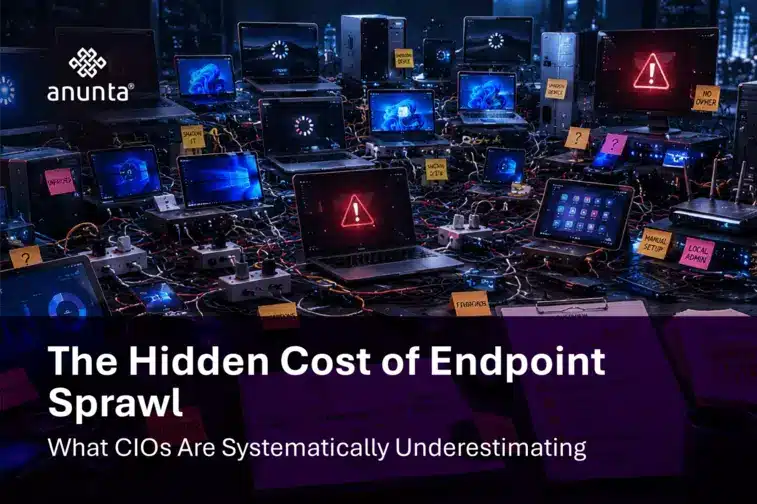
Endpoint sprawl is exposing hidden costs: Diminished visibility, greater compliance burden, support fatigue, and a shift from transformation to managing unnecessary complexity.
Endpoint management is now essential for workforce productivity, governance, compliance, and scalable digital transformation.
Any unmanaged endpoints will create friction at some point within the enterprise.
Therefore, organizations invest in Managed Endpoint Services to centralize governance, automate operations, and create scalable digital workspaces.
Unmanaged endpoint lifecycles quietly accumulate substantial financial and operational costs, often surfacing only at crisis points.
Most organizations can tell you how many devices they own. However, far fewer can tell you how much inefficient usage of those devices is not accounted for within their IT budgets.
For example, a dormant laptop still uses a license. In a 10-department organization, each might unknowingly have its own licensed copy of the same application. Or, some endpoints miss critical patches after being out of view.
Endpoint sprawl grows slowly and steadily due to disparate systems and poor governance. It creates the first level of IT tech sprawl productivity loss, ultimately slowing down business agility.
Ivanti research shows that 40% of IT professionals believe there is an organizational silo that reduces IT efficiency levels. The loss of even a few hours per week due to poor, disconnected, or invalid workflows can lead to thousands of operational hours wasted each year.
The same issue is true in the software ecosystem. A recent Gartner study found that one-third of enterprise cloud spending has no quantifiable business value, often due to a lack of application visibility and duplicative tooling.
These examples are representative of the SaaS sprawl hidden costs.
For CIOs, unchecked endpoint proliferation creates fragmented oversight, making it harder to achieve digital clarity and business value.
Almost any technology can now be adopted by a business without IT involvement.
Business units deploy their own tools, and employees use third-party apps without proper IT authorization. With more remote work, organizations face more endpoints to secure.
Gartner has estimated that by 2025, 69% of workers will create, procure, or modify technology without formal IT oversight.
The increase in shadow IT significantly increases the enterprise’s Total Cost of Ownership of enterprise applications and creates operational inefficiencies. Duplicate software purchases create operational waste; unmanaged applications create inconsistency and deprive the organization of a complete view of all endpoints.
These blind spots in asset visibility make proactive governance impractical, risking unexpected costs and inefficiencies.
Many organizations that lack a consolidated view of endpoints only become aware of operational gaps after they are identified during an audit, brought to light by a security breach, or surface unexpectedly due to a delay in implementing a digital transformation initiative.
The complexity of endpoint compliance is increasing exponentially as endpoint environments become more fragmented; as a result, each unmanaged endpoint device increases overhead for audit, remediation, and policy implementation.
This is the escalating reality of the overhead of endpoint security compliance.
Organizations without centralized governance typically incur much higher remediation and compliance costs than those with consolidated endpoint programs.
Patch management fragmentation worsens issues. When multiple tools and teams manage patches, swift identification and response are more difficult.
In regulated industries, the longer responses take, the greater the operational risk and the greater the exposure to compliance risk from delayed updates. For CIO’s, endpoint governance is no longer simply operational; it has become strategic.
Anunta’s Managed Endpoint Services help enterprises centralize governance, automate compliance workflows, and enhance endpoint resilience across distributed environments.
Operational debt grows through obsolete processes, isolated technology, and outdated manual practices.
So, how can organizations address this issue? By focusing on IT operational debt reduction.
Disconnected endpoints drain IT budgets by up to 20% through duplicated or ineffective management, consuming resources that could be used to drive transformation.
IT teams become trapped in maintenance cycles, unable to focus on innovation.
Treat endpoint consolidation as critical to business optimization, enabling efficiency, automation, and transformation capacity.
Many companies are finding new ways to reduce their reliance on human intervention in how they operate at the end of their networks, and this shift toward autonomous endpoints is driving the push to use AEM within organizations. With autonomous technologies, organizations benefit from having:
Automation provides benefits beyond making processes easier; it frees up IT staff’s time to focus on strategic transformation rather than routine maintenance.
According to Gartner, more than half of organizations will implement some form of autonomous endpoint within the next 6 years.
Since Managed Endpoints Services will provide organizations with a centralized location to manage all aspects of their endpoint infrastructure, and to help automate governance processes and improve compliance visibility, as well as allowing organizations to securely scale and grow without the additional burden of increased operational costs, Managed Services for Endpoints are extremely valuable to any organization that wants to implement an AI Implementation strategy.
CIOs preparing for AI implementation must first modernize endpoint infrastructure. Fragmented endpoint management weakens organization-wide visibility and undermines scalable transformation.
Anunta’s Digital Workspace Solutions and Workspace ONE Expertise help enterprises build secure, scalable, AI-ready digital workplace ecosystems.
A leading national cooperative bank operating across 198 branches and 11 Indian states struggled to manage more than 1,200 devices across its distributed workforce.
Endpoint visibility was limited, software updates were inconsistent, and compliance reporting was manual.
To modernize the environment, Anunta implemented a digital workspace solution using Omnissa Workspace ONE, centralizing endpoint visibility, automating onboarding, and enabling secure role-based access.
The outcomes included:
Explore the full National Cooperative Bank Case Study.
A subsidiary of a UAE-based financial conglomerate faced growing complexity in managing Android, iOS, macOS, and Windows devices across its environment.
Endpoint visibility remained fragmented, while compliance obligations and remote workforce requirements continued expanding.
Anunta implemented a unified endpoint management framework using Omnissa Workspace ONE UEM and Workspace ONE Access.
The deployment centralized device management, automated policy enforcement, and strengthened secure remote access capabilities.
The organization gained:
For CIOs in regulated industries, endpoint governance is no longer just infrastructure management.
It is operational resilience at scale.
Explore the full UAE Financial Conglomerate Case Study.
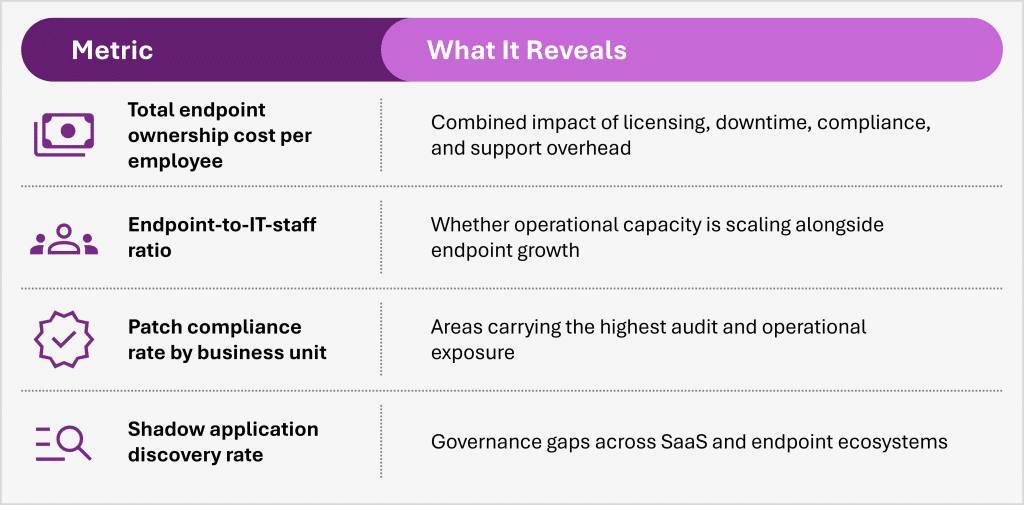
For CIOs, these are no longer just operational metrics.
They are strategic visibility indicators shaping long-term transformation planning.
“The financial and operational cost of an unmanaged endpoint lifecycle is rarely visible until it becomes a crisis. By the time it appears on the board’s agenda, it has already cost more than prevention ever would have.”
Endpoint sprawl rarely appears dramatically.
It surfaces gradually through fragmented workflows, rising operational overhead, delayed transformation initiatives, and exhausted IT teams.
Before the next strategic planning cycle:
Organizations that modernize endpoint governance early gain more than efficiency. They gain the ability to scale transformation with confidence.
Explore Managed Endpoint Services to build a secure, scalable, AI-ready digital workplace.