It’s 2:13 a.m. A critical application starts slowing down.
The monitoring system detects the anomaly before users report it. AI correlates the logs, metrics, and recent changes, identifies the likely cause, and recommends a fix.
The operations team now knows what happened. They know why it happened. They even know what they should do next.
But the problem is still there.
Someone still must review the recommendation, decide whether the action is safe, approve it, and execute it.
That gap between knowing what to do and actually doing it is becoming one of the most important questions in enterprise IT operations.
AI has become remarkably good at detecting, diagnosing, and explaining problems. The next shift is giving it the ability to act on what it finds.
But that raises a more important question than whether AI can take action:
Which actions should it be allowed to take—and who decides?
Agentic AI in IT operations is AI that can plan and execute defined fixes, such as restarting a stalled service or reclaiming idle cloud capacity, within guardrails the enterprise sets in advance. Traditional AIOps detect and explain problems; agentic AI acts on them. Which actions it takes is decided by risk and volume, and autonomy expands only as the system proves it can be trusted.
To see why that matters, it helps to start with what AIOps already do well.
Most enterprise IT teams are not short on intelligence. Modern AIOps platforms correlate logs, metrics, and events across a hybrid estate faster than any human team could, flag the anomaly, rank it by severity, and hand a clear explanation to whoever is on call.
According to Everest Group’s analysis of AI-powered observability, enterprise adoption is evolving through three stages: Assist, Analyze, and Act, each representing deeper integration of AI into operational decision-making. The investment outlook is equally significant: nearly 74% of enterprises plan to increase AI or generative AI spending by more than 10% over the next two years.
The challenge is that intelligence and action do not always move at the same pace.
A system can tell an operations team precisely what is wrong, but a person may still have to read the findings, judge the risk, and act before anything in the environment changes.
That is where the next shift begins.
AIOps has already helped enterprises move from simply monitoring IT environments to using AI to detect anomalies, analyze their causes, and recommend responses. Agentic AI takes the next step by enabling AI systems to act on those recommendations—within defined rules and guardrails—rather than leaving every remediation to a human operator.
The next stage does not ask AI to see more. It asks AI to do something with what it already sees.
Agentic AI can move beyond identifying a problem or recommending a response to planning and executing a defined remediation within guardrails that the enterprise sets in advance.
The distinction is simple:
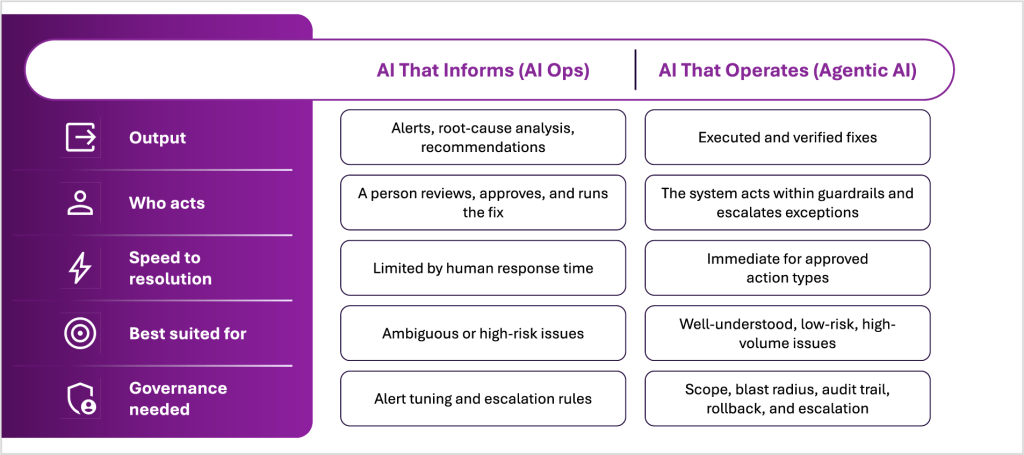
AI that informs improves awareness. AI that operates changes the environment’s state.
The value lies in moving safely from one to the other.
Consider endpoint management.
A failing endpoint could trigger an alert, generate a recommendation, and wait for an administrator to open a ticket and determine what to do.
An operational AI system can take a different approach. When a known-safe condition is confirmed, it can isolate, restart, patch, or reconfigure the endpoint without waiting for a ticket to move through a queue. It can then verify the outcome and escalate if the result falls outside the expected parameters.
The system does not just tell operations what to fix.
It fixes it.
That is the operational shift.
None of this means every fix belongs on autopilot.
Blanket automation is exactly how agentic AI programs lose the trust of the operations teams meant to rely on them. A restart on a stalled service carries almost no downside if the system gets it wrong. A change to a production database schema, a security policy, or a customer-facing configuration can carry a significant business impact.
The safer starting point separates actions by risk and volume, not by ambition:
The real decision enterprises face is not whether to automate.
It is selecting which actions have earned the right to run without someone watching, and which ones still need human judgment because the risk, ambiguity, or blast radius is too high.
Every operational AI program eventually must answer the same set of questions for each class of IT event that crosses its desk:
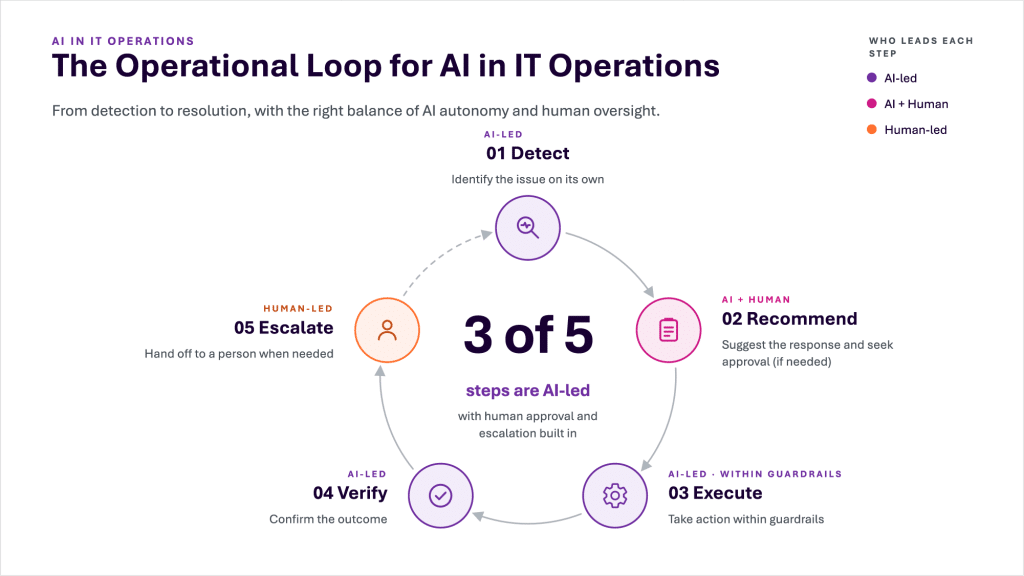
This framework provides a more useful way to think about the evolution from traditional AIOps toward operational or agentic AI.
The question is no longer simply whether AI can identify an incident.
It is where in the operational loop AI should participate—and how much autonomy it should have at each stage.
The more control an AI system has over an IT environment, the more important governance becomes.
Gartner predicts that by 2029, at least 70% of organizations running production agentic AI in infrastructure and operations will experience a material service, security, or cost incident linked in part to insufficient runtime controls.
That warning reframes governance as an operating requirement, not a policy formality.
Every autonomous action needs:
Progressive autonomy is what makes that governance workable in practice.
Scope should widen only as the platform earns a track record, moving from individual, well-understood actions toward broader cross-environment orchestration over time—not all at once.
A practical path toward operational AI does not begin with giving an AI system unrestricted control.
It begins with identifying the right workflows.
This is not a plan to remove operations teams from the loop.
It changes what they spend their time on.
Engineers set policy, define the blast radius for autonomous actions, and review exceptions that the system was not confident enough to resolve on its own. That is a materially different role from reading every alert that comes through the queue.
The objective is not less human judgment.
It is better use of human judgment.
Anunta has already applied this operate-not-report model in production.
Its CloudOptimal™ platform used automated power management, rather than a recommendation dashboard, to help a bank operating more than 2,600 branches cut cloud costs by 40% within two months, as documented in Anunta’s published case study.
The operational lesson is the important part: the measurable value came from trusted execution within defined limits, not from another insight waiting in a queue. The platform acted directly on the environment, within defined limits, rather than leaving the decision sitting in a report that someone might get to later.
That same principle applies to autonomous IT operations and endpoint remediation.
The value is not simply in producing another recommendation.
It is in what changes in the environment because the system is trusted to act.
The difference between AI that informs and AI that operates is ultimately not about how much intelligence a system has.
It is about what happens after the system understands the problem.
The next step for enterprise IT is not to hand every operational decision to AI. It is to identify where autonomous action is safe, define the guardrails around it, and expand that autonomy as the system proves it can be trusted.
The goal is not to remove people from IT operations. It is to move people away from repetitive intervention and toward decisions that genuinely require human judgment.
The future of IT operations isn’t AI that sees more. It’s AI that can safely act on what it sees.
Visit Anunta’s website to talk to an expert about which of your workflows are ready for operational AI.
Q: What is agentic AIOps?
A: Agentic AIOps combines traditional AIOps correlation and analytics with agentic AI’s ability to plan and execute remediation within defined policy limits. Instead of only flagging an anomaly, the system can determine an appropriate corrective action, carry it out, and report what it did.
Q: What is the difference between AIOps and AgenticOps?
A: AIOps focuses on detecting patterns across logs, metrics, and events to speed up human diagnosis. AgenticOps describes a more autonomous operating model in which AI can take defined corrective actions once established conditions and guardrails are met.
The distinction is not absolute: AIOps platforms can include automation, while agentic systems can operate at different levels of autonomy.
Q: How do autonomous IT operations compare with traditional AIOps in practice?
A: Traditional AIOps can significantly shorten the time required to detect and diagnose a problem. Autonomous IT operations can remove the final human handoff for well-defined, lower-risk scenarios, allowing detection, decision, action, and verification to happen within the same workflow.
Q: What does AI governance for autonomous IT actions actually involve?
A: It includes defined scope, blast-radius controls, audit trails, tested rollback mechanisms, and clear escalation paths. These controls should be designed into the operating model before autonomous actions are allowed to run without human approval.
Q: What kind of endpoint issues can an autonomous endpoint remediation solution actually fix on its own?
A: Well-understood, high-volume issues are generally the best candidates, including stalled services, known configuration drift, disk-space exhaustion, and failed patches where a documented safe rollback exists. Ambiguous or high-impact changes should continue to involve human judgment.