It looks like you're using Firefox in strict privacy mode, which may block some features on this site. To enable
all functionalities, please adjust your Goto Privacy Settings -> Click Standard.
Citrix to Azure Virtual Desktop Migration: A Step-by-Step Guide for Enterprise IT
IT Infrastructure Services
Posted on April 17, 2026
Enterprise IT is transitioning into a timeframe where waiting could result in enormous expenses.
Changes in Citrix’s licensing and ownership models have driven unpredictability into what was once a stable environment, along with increased licensing fee amounts. Contracts are becoming rigid, thus quietly yet consistently increasing operational overheads.
Additionally, Azure Virtual Desktop (AVD) has matured into a cloud-native platform with a consumption-based price model, integrated security features, and unified identity services that are developed specifically for modern day IT operational processes.
However, this shift should not be categorized as gradual, but more as a pivot point of focus for the organization, where their decision for Citrix to Azure Virtual Desktop migration has now shifted to a focus on control over cost, risk, and agility today, versus future readiness.
The three principles driving the impetus to act immediately are as follows:
Increasing and variable pricing for the licensing of Citrix environments
The establishment of a center of excellence leveraging across hybrid cloud environments and cloud-first models enterprise-wide
The fragmented infrastructure is placing an increased amount of operational strain on the organization. Therefore, failure to act will result in the organization causing instability rather than creating new risks.
Citrix vs Azure Virtual Desktop: A Strategic Shift, Not a Feature Comparison
Customizable Citrix environments offer flexibility, but the cost associated with providing that flexibility results in operational drag due to the ongoing management requirements of supporting controllers, storefronts, Netscaler, and multiple other components. Over time, this operational drag can accumulate, so Azure shed this drag and was designed from the ground up to eliminate operational drag.
When Azure Virtual Desktop was created and designed for this purpose, it natively connects to Microsoft Azure and builds a seamless connection with Microsoft 365, Entra ID, Intune, and Microsoft Defender, which provide unified identity, access, and security capabilities across a single control plane. This represents a major shift away from operating in a Citrix environment, where managing the multiple components is complex and requires continuous management.
On the other hand, AVD has embedded complexity into the platform, making it easy for enterprises already engaged within the Microsoft ecosystem to eliminate redundant tooling throughout their organization, gain greater governance over the entire enterprise via unified policy, and execute tasks with increased speed without multiple infrastructure dependencies.
A Citrix Vs azure virtual desktop evaluation is no longer just a technical comparison; it is also an evaluation of which option best aligns with an enterprise’s strategy.
Why Enterprises Are Moving Now: Measurable Outcomes
Outcomes that have a direct effect on business performance are influencing the transition to Azure Virtual Desktop (AVD).
Cost Control and Predictability – Commonly, Citrix environments have a layered licensing model combined with fixed capacity planning, which results in inflated Total Cost of Ownership. AVD cost structure is based on actual usage and takes advantage of existing Microsoft 365 licensing. Results: Reduction in spend variability along with an increase in financial visibility.
Risk Reduction – Citrix environments typically contain multiple dependencies and components, which elevates the overall operational risk profile of the organisation. AVD provides a streamlined architecture by leveraging the native integrations to eliminate any external dependencies. Results: AVD has many fewer points of failure and reduces the overall dependency risk.
Security Alignment – AVD integrates seamlessly with Microsoft Defender, Sentinel, and Conditional Access. Results: AVD provides an overall enhanced cloud security posture and makes it easier to enforce Zero Trust policies.
Operational Agility – AVD enables dynamic scaling across hybrid cloud environments without duplicating infrastructure resources. Results: AVD provides organisations with the ability to quickly react to changes within their business needs.
The reason organisations are making the transition to AVD is not that it’s new; rather, it’s because it is aligned with the current realities for IT in today’s world
The Migration Journey: Structured for Control and Speed
A successful Citrix to Azure Virtual Desktop migration will require utilizing a defined and outcome-driven methodology to get there. This entire process can be broken down into four individual phases.
1. Assess: Establish Clarity and Reduce Risk
Having a clear picture of your existing environment will eliminate the potential for disruption down the road.
Create an inventory of all Citrix components – Controllers, StoreFront, NetScaler, VDAs
Map out your current security controls to equivalent cloud security controls
Outcome: A validated baseline will decrease uncertainty and speed up execution.
2. Design: Build for Scale and Efficiency
Design Decisions impact both long-term costs and performance possibilities.
Define host pool strategy based on workload requirements
Establish Identity and Access Management with Entra ID or a hybrid
Configure FSLogix profile containers to optimize performance
Design a secure Azure Networking solution using VNets, NSGs, and Private Endpoints
Outcome: A scalable, resilient Azure Virtual Desktop setup.
3. Migrate: Execute with Precision
Migration must be approached in a phased, measurable manner and be tightly controlled.
Establishing a clean Azure environment to cover subscriptions, networking, and storage
Creating standardised images that are not reliant on legacy Citrix components
Deploying the host pool and testing for performance
Migrating the pilot users and refining their configuration
Rolling out in phases and having a functional rollback plan
Outcome: A low-disruption solution with increased user confidence.
4. Optimize: Drive Continuous Value
The beginning of migration begins the pathway to long-term efficiency.
Legacy Citrix components will be decommissioned in phases
Using Azure’s Cost Management to manage the alignment of usage and demand
Continuously refine the sizing and scaling policy of the host pool
Real-time monitoring of the user experience and performance
Outcome: Sustained cost efficiency and performance.
Common Challenges and How Enterprises Navigate Them
Cloud infrastructure migration can present challenges; however, these challenges are easily predicted and manageable.
Application Compatibility – Early Validation Prevents Rework and Delays
Profile Migration – Structured Transition from Citrix UPM to FSLogix will preserve the Integrity of User Profile Data
Network Performance – Optimized Routing and Region Selection provides the User Experience
User Adoption – Clear Communication Reduces Resistance during the Transition Process Preparation Converts the Challenges into Controlled Execution Steps
Best Practices for a Secure and Stable Migration
Consistency and Discipline are the keys to success!
Create Clean and Optimized AVD Images
Define FSLogix Configurations Early to Ensure Consistent Performance
Integrate Cloud Security Controls into Every User Session
Implement Conditional Access, MFA, and Compliance Policies from Day One
Align Operational Teams to Support Monitoring and Governance Strong Endpoint Management is Critical to Ensuring Stability across User Environments.
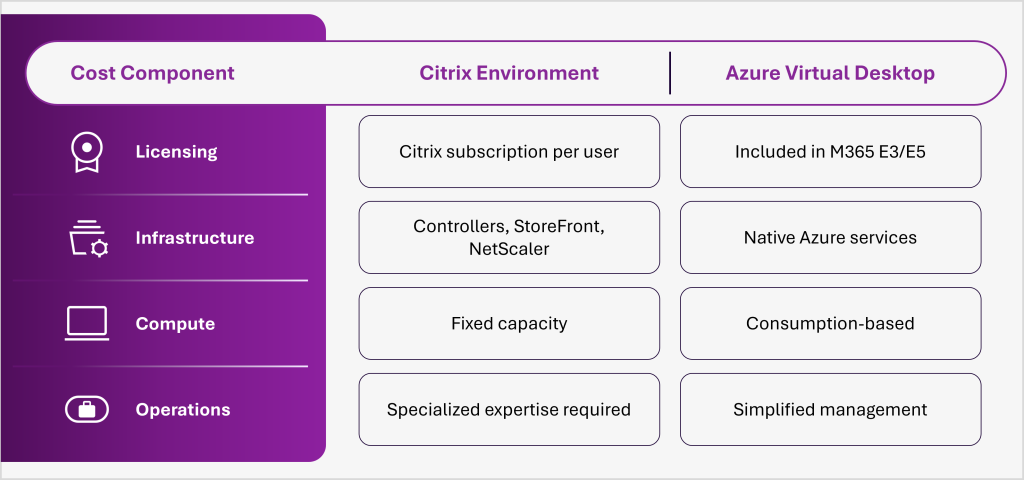
Citrix vs Azure Virtual Desktop: The Cost Equation
A managed Azure Virtual Desktop model simplifies cost structures while aligning spend with usage. This cost clarity drives executive decisions.
A citrix vs azure virtual desktop analysis consistently shows:
Lower licensing overhead
Cost aligned to actual usage
Reduced operational complexity
Most enterprises recover migration investment within 12 to 18 months, with continued efficiency gains over time.
Timing Will Define the Outcome
Waiting longer than the contract expiration date adds pressure. Acting sooner provides an edge.
When organizations actively pursue a Citrix to Azure Virtual Desktop migration, they reap the benefits of:
cost-effective solutions
clearly defined timelines for execution
lower risk of transition By not acting soon enough, organizations are more likely to make decisions with limited options and increased costs.
Waiting for contract expiration creates pressure. Acting early creates an advantage.
Why Anunta: Turning Strategy into Measurable Impact
Execution is what determines whether or not your transformation is a success. We provide accurate and accountable Cloud Infrastructure migration-related services through Anunta:
Complete ownership and accountability from initial assessment through optimizing your solution.
Proven frameworks for migrating at an enterprise level.
Accountability for day-to-day operations from “Day 0” to “Day 2”. For example, one of our enterprise customers, who operates in the healthcare space, was able to save over $1 million just a few weeks after migrating while experiencing a significant improvement in overall user experience and operational visibility. This is not an incremental improvement. It is a measurable business impact. Explore real-world outcomes through Azure Virtual Desktop case studies.
Act Before Cost and Risk Compound
You are well aware that the transition to the Azure Virtual Desktop (AVD) is already in motion among most organizations.
There is no benefit to waiting; there is only benefit for those who act first and with confidence.
You are currently in your Citrix renewal window, so you should already be exploring your options.