Your cloud bill is not a finance document. It is an operations document that finance receives at the end of the month. Every idle virtual desktop, oversized VM pool, and unattended dev instance in your workspace environment is a technical decision made weeks earlier, and finance only finds out about it once the invoice lands. Treating cloud waste as something the finance team should catch and control is asking the wrong department to fix a problem it cannot see. That is why the issue starts with operations, not accounting.
The scale of the problem is not shrinking. Worldwide end-user spending on public cloud services is forecast to reach $723.4 billion in 2025, up from $595.7 billion in 2024, a 21.5% jump in a single year, according to Gartner. Cloud infrastructure and platform services alone are growing even faster, up 24.2% to $301 billion and now accounting for 72% of IaaS and PaaS spending, the same Gartner forecast shows. That is not enterprises spending more because they need more. It is enterprises spending more, while visibility into what they are actually using has not kept pace.
Picture an enterprise running 3,000 virtual desktops across three regions to support a hybrid workforce. Half the fleet sits idle overnight and on weekends, sized for peak Monday-morning login storms rather than average daily use. Finance sees one number: the monthly Azure or AWS invoice. Nobody in finance can see which desktop pool is oversized, which region is overprovisioned, or which project team spun up test environments that were never shut down. That gap, not a lack of budget discipline, is where the money disappears, and it is the gap that the next section defines.
Let’s be honest about where the waste actually comes from. A Gartner survey found that organizations run their cloud environments at an average of 35% waste, ranging from 15% in highly optimized environments to as much as 55% where no formal optimization program exists. That is not a rounding error. It is a swing wide enough to fund an entire second initiative, depending purely on whether anyone is actively managing the environment.
Gartner’s own Peer Community research on 2024 cloud spending backs this up from the buyer’s side. 69% of IT leaders surveyed reported that their organization exceeded its cloud budget the previous year, while the smaller group who stayed within budget credited it to accurate budgeting and forecasting (66%), proactive spend monitoring (61%), and effective resource optimization (48%), according to Gartner. Notice what is missing from that list. None of the organizations that stayed on budget credited finance oversight as the fix. They credited operational visibility, which is the transition from waste to control.
For a workspace environment specifically, this compounds fast. Virtual desktop pools are provisioned for peak concurrency, not average use, and idle computers sitting unused overnight or on weekends are exactly the kind of waste a monthly finance review structurally cannot catch, because by the time the invoice arrives, the idle window has already closed. Every quarter that gap goes unmeasured is another quarter of real money spent on desktops nobody is sitting in front of.
The first mistake most enterprises make is asking finance to police spending it cannot monitor. Finance can see the total invoice. It cannot see which specific desktop pool, session host, or resource group is driving that number, because that data lives in the cloud platform’s own metrics, not in a spreadsheet. Real cost accountability starts with the teams that provision infrastructure having the same visibility that finance is expected to act on. From there, the ownership model becomes practical.
Cost accountability works best as a shared, continuous discipline between IT operations and finance, not a once-a-quarter finance-led audit. IT operations owns the provisioning decisions and the tooling to catch waste in real time. Finance owns the budget context and the business priorities that those numbers need to map to. Neither team can do this well in isolation, and Gartner’s own 52% figure on rising cost-reduction pressure over the next two years, drawn from the 2026 Gartner CIO and Technology Executive Survey, means this shared ownership model is about to be tested harder, not less, across every enterprise IT function. That shared model is why automation matters next.
Manual review cannot keep pace with a workspace environment that scales dynamically by the hour. Automated rightsizing, scheduled shutdowns for non-production environments, and continuous rather than periodic monitoring are what actually close the gap between what infrastructure is provisioned and what infrastructure is actually needed. Once that gap is closed, the business impact becomes easier to show.
Think about what changes when a CIO can show the board not just a lower cloud bill, but a workspace environment that scales cost with actual usage instead of peak provisioning. That freed budget does not disappear. It funds the next VDI expansion, the AI-driven employee experience initiative, or the security upgrade that was previously stuck behind a flat IT budget. Cloud cost optimization done well is not a cost-cutting exercise. It is a funding mechanism for everything else IT wants to do next, which is why the right tooling matters.
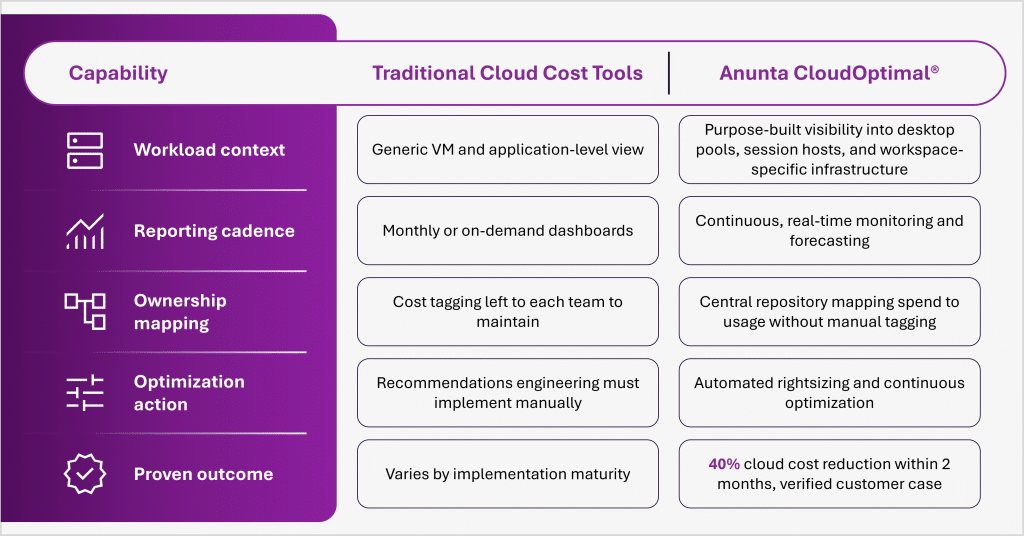
Most generic cloud cost management tools were built for infrastructure teams managing application workloads, not for the specific shape of a workspace environment, where desktop pools, session hosts, and end-user computers behave differently from a typical VM fleet. Anunta’s CloudOptimal® was purpose-built with that difference in mind, and a real customer engagement shows exactly why that matters. The example below makes the gap clear.
A major national bank operating more than 2,600 branches was running a large virtual desktop and workspace infrastructure with rapidly rising cloud costs and no proportional return. The bank had limited visibility into usage, idle virtual machines sitting unnoticed, over-provisioned resources across its environment, and an infrastructure team managing everything manually, with no forecasting or analytics to plan ahead. Anunta implemented CloudOptimal® to give the bank real-time monitoring, workload-level analytics, and automation across its environment. Within a two-month window, the bank achieved a 40% reduction in cloud costs, a result that a generic, application-focused cost dashboard would not have surfaced, because it would not have understood which idle resources belonged to which desktop pool or business unit in the first place. That result leads directly to the approach enterprises should take. Here’s how Anunta’s Cloud experts did it.
First, get resource-level visibility before assigning blame or setting targets. You cannot optimize what finance and IT cannot both see in the same dashboard, and Gartner’s 35% average waste figure exists precisely because most organizations skip this step. Start here, then move to ownership.
Second, put ownership where decisions are actually made. IT operations should own day-to-day optimization, with finance as a stakeholder in the priorities, not as the sole enforcer after the fact.
Lastly, automate the repetitive work before it accumulates. Rightsizing, scheduled shutdowns, and forecasting should run continuously, not as a quarterly cleanup project, so the 69% budget-overrun outcome Gartner found among under-instrumented organizations does not become your own. This sequence closes the loop before the conclusion.
Cloud cost optimization in a workspace environment fails when it is treated as a finance problem, because finance was never given the tools to see the waste in the first place. It succeeds when IT operations owns visibility and automation, with finance as an informed partner rather than an after-the-fact auditor. The closing point is simple: IT should own the tools and daily execution, while finance should stay informed and aligned. Anunta CloudOptimal® gives enterprises the workspace-specific visibility, automation, and forecasting that generic cost tools were never built to provide, backed by a verified customer result of a 40% cloud cost reduction in two months. In other words, it turns the earlier visibility gap into a managed process.
Talk to an Anunta cloud optimization expert about what CloudOptimal® could uncover in your own workspace environment.
1. Why isn’t cloud cost optimization primarily a finance responsibility?
Finance can see the total invoice but cannot see which desktop pool, session host, or resource group is driving that cost, because that data lives in the cloud platform itself. Gartner’s own research found that organizations that stayed within budget credited accurate forecasting, proactive monitoring, and resource optimization, not finance oversight, as the reason.
2. How much cloud spend is typically wasted in an unoptimized environment?
According to a Gartner survey, organizations run their cloud environments at an average of 35% waste, ranging from 15% in highly optimized environments to as much as 55% where no formal optimization program is in place.
3.What makesAnunta CloudOptimal® different from generic cloud cost management tools?
CloudOptimal® was purpose-built for workspace environments, giving visibility into desktop pools and session hosts specifically, rather than a generic application-level VM view. In a verified customer case, this workspace-specific approach delivered a 40% reduction in cloud costs for a major bank within two months.
4. Should IT or finance own cloud cost optimization?
IT operations should own day-to-day optimization decisions and tooling, since that is where provisioning happens and waste can actually be caught in real time. Finance remains an important stakeholder for the budget context and business priorities, but should not be the sole enforcer of a process it cannot instrument itself.
5. How quickly can a workspace environment see results from cloud cost optimization?
Results can come faster than most enterprises expect. In Anunta’s published case study, a national bank with over 2,600 branches achieved a 40% reduction in cloud costs within two months of deploying CloudOptimal®, driven by real-time visibility, automated rightsizing, and scheduled power management.