Enterprise IT is undergoing a fundamental shift. According to Gartner, virtual desktops are expected to support 95% of workers by 2027, up from 40% in 2019. This is more than an adoption trend. It signals that the traditional endpoint-centric workplace is giving way to a cloud-first, experience-driven model.
Organizations are increasingly turning to Desktop as a Service solutions for enterprise environments to support hybrid work, strengthen security, improve resilience, and simplify operations. As enterprises accelerate AI adoption and digital transformation initiatives, the desktop is becoming a strategic asset rather than a managed device.
At Anunta, we’ve seen this evolution unfold across global enterprises in BFSI, healthcare, manufacturing, and technology sectors. The organizations leading this transition aren’t treating DaaS as an IT project; they’re treating it as a business enabler.
For organizations asking what DaaS in cloud computing is, the answer is straightforward.
Desktop as a Service is a cloud-based model in which a managed DaaS provider hosts and manages desktops, applications, operating systems, and data within a secure cloud environment. Users access their workspace from any device while compute, storage, security, and policies remain centralized.
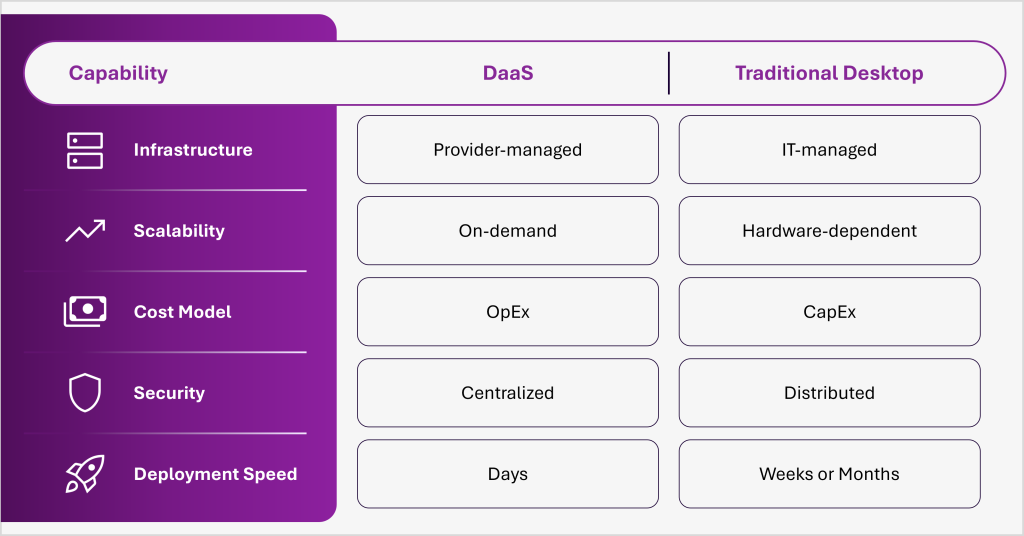
This centralized architecture is one reason organizations are increasingly adopting cloud desktop services for business. It reduces operational complexity and supports better governance and user experience.
DaaS is not confined to merely “where” the desktops are located, but rather “how” those desktops function intelligently.
At Anunta, we see a continual shift toward AI-powered DaaS environments that proactively optimize performance, security, and user experience as organizations move away from traditional virtualization methods.
Proactive Resource Management – AI analyzes desktop usage patterns, app behavior, and workload trends to monitor resource usage on the user’s desktop and allocate resources before potential performance issues arise.
Self-Healing Desktop – With the emergence of the self-healing desktop enterprise, the methodology of an IT support group has changed. Rather than waiting for the IT support group to generate a support ticket when an end-user raises an issue, AI uses anomaly detection techniques to identify the root cause and trigger auto-remediation. This minimizes downtime, maximizes employee productivity, and allows IT support groups to focus on strategy.
Autonomous Desktop Management – The next generation of remote desktop services will use autonomous desktop management, incorporating AI to automate patching, compliance validation, configuration auditing, and threat detection.
As enterprises embrace agentic AI for IT operations, traditional DaaS deployment will become an essential resource for implementing intelligent automation in next-generation business operations.
The benefits of Desktop as a Service extend far beyond desktop delivery. Let’s review some of them –
Security concerns often dominate DaaS discussions. In reality, modern DaaS environments can offer stronger protection than traditional endpoint models.
A mature DaaS security and compliance enterprise strategy includes:
Because data remains centralized, compliance can be easier to manage and audit. Leading DaaS environments support frameworks such as ISO 27001, SOC 2 Type II, HIPAA, GDPR, PCI DSS, and NIST.
Anunta’s managed services teams help enterprises maintain continuous compliance while reducing operational overhead associated with patching, vulnerability management, and monitoring.
Hybrid work is no longer an exception. It is the enterprise operating model.
A hybrid work virtual desktop solution enables employees to access a consistent workspace experience from the office, home, client sites, or while traveling.
This capability is especially valuable in highly regulated industries.
Financial advisors can securely access trading platforms from any location. Healthcare professionals can access patient records without exposing sensitive data. Manufacturers can provide engineers with secure access to ERP and MES systems across multiple facilities.
Anunta recently helped a leading steel manufacturer transform its Azure Virtual Desktop environment. The engagement improved performance, strengthened resilience, and enhanced user experience.
The project reinforced an important lesson: successful DaaS initiatives are about enabling business agility, not just desktops.
Five major developments will shape the future of cloud desktop technology.
Agentic AI Operations, where AI will diagnose, optimize, and find solutions for problems on its own.
Edge-Based DaaS will provide users with a better desktop experience by reducing latency in sensitive industries.
DaaS and SASE convergence, where networks and security policies will be more integrated.
Unified Endpoint Governance, where organizations will have one control point for desktops, mobile devices, and BYOD devices.
Consumption-based pricing, which will give organizations more options for enterprise-level DaaS.
These five trends are transforming DaaS from an infrastructure service into a strategic business platform.
As DaaS evolves, execution matters as much as technology.
Unlike general cloud providers that offer DaaS as one service among many, Anunta has built its reputation around digital workspace transformation and end-user computing excellence.
Our capabilities include:
This specialized focus has enabled Anunta to help organizations modernize workspaces while maintaining security, performance, and business continuity.
A lot is changing in the workplace; workers create digital experiences, and we need more flexible ways for them to do so. The pace of change driven by artificial intelligence and other advances, such as hybrid work models, has made traditional models and services unable to support current or forecast workforce needs.
DaaS addresses this change through centralizing management, simplifying processes, improving security, and enabling agility. However, technology is only one factor in success; the organizations that will succeed with DaaS will be those that use the right technologies and the right DaaS-specific experience.
To this end, Anunta’s experience is invaluable.
Anunta has delivered and managed digital workspaces for companies across industries worldwide. Anunta knows that DaaS is not simply about hosting desktops in a cloud. Instead, Anunta believes that creating high-performing, intelligent, and flexible work environments for employees is paramount to accelerating business results through DaaS technology and tools.
Enterprise leaders are no longer challenged by the question of whether DaaS is part of their strategy; the most important issue facing them today is how quickly they can leverage DaaS to gain a competitive advantage.
Ready to future-proof your digital workspace strategy? Connect with Anunta’s DaaS experts for a personalized assessment and discover how an intelligent, secure, and scalable desktop environment can accelerate your business goals.
1. What is Desktop as a Service (DaaS) in cloud computing?
DaaS is a cloud-based virtual desktop model where a managed DaaS provider hosts the entire desktop environment – OS, apps, and data – and delivers it to any device over the internet. Nothing is stored on the endpoint. The provider manages infrastructure, security, patching, and performance.
2. How does AI change Desktop as a Service?
AI-powered DaaS enables predictive resource scaling, self-healing desktops that resolve issues before users notice, and autonomous patch management. Rather than waiting for a ticket, the system detects, diagnoses, and remediates – reducing helpdesk volume and improving user experience simultaneously.
3. Is DaaS secure enough for regulated industries like healthcare and BFSI?
Yes. DaaS centralizes all data in a secure provider environment – no sensitive data touches the endpoint device. Built-in controls include MFA, RBAC, encrypted sessions, and DLP. Managed DaaS providers like Anunta support compliance with HIPAA, PCI-DSS, SOC 2 Type II, ISO 27001, and GDPR.
4. How long does a DaaS deployment take?
Most enterprises working with an experienced managed DaaS provider complete a production-ready deployment in 4–8 weeks, including security hardening, user migration, and integration with existing identity providers and Microsoft 365 environments.