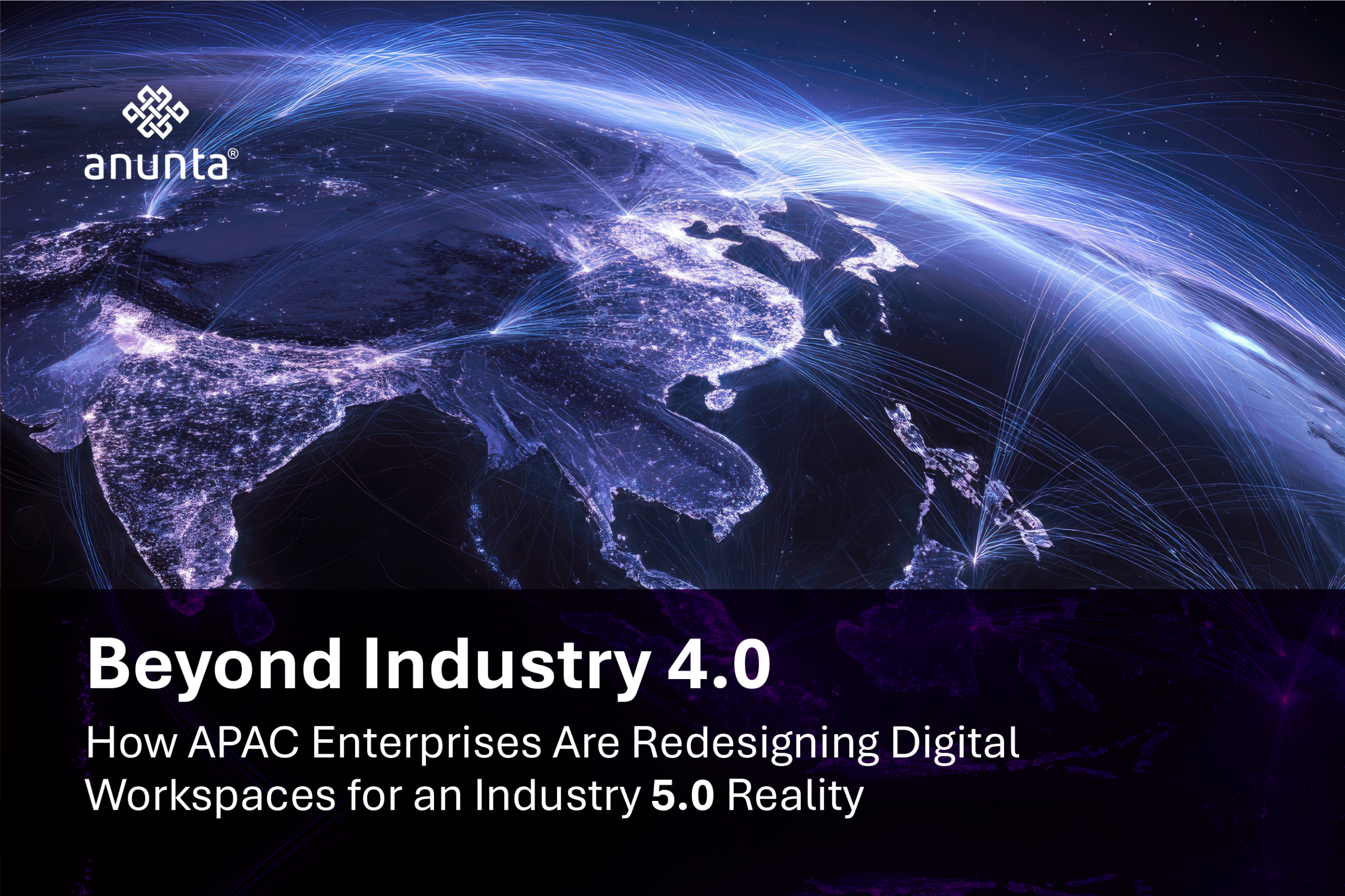
Across the Asia-Pacific, the last decade of digital transformation has been defined by speed, scale, and ambition. Automation, connected systems, cloud platforms, and data-driven decision-making are now embedded across manufacturing plants, financial institutions, healthcare systems, and supply chains.
Yet a new reality is emerging.
Industry 4.0 helped organizations digitize. Industry 5.0 is forcing them to stabilize, humanize, and sustain what has been built. For operational leaders, this is not a theoretical shift. It is visible in daily decisions, workforce behavior, system performance, and risk exposure.
Digital ambition across APAC remains high. The challenge now is ensuring that this ambition can be operated reliably at scale.
The Asia-Pacific region does not behave like a single market. It operates as a complex, multi-speed ecosystem.
Regulatory environments differ widely across countries, forcing organizations to comply with multiple frameworks simultaneously. Workforce maturity varies across developed and emerging economies, which directly affects how digital tools are adopted and sustained. Procurement autonomy across markets often leads to vendor sprawl, creating fragmented technology estates beneath otherwise modern platforms.
At the same time, APAC is unique in the convergence of manufacturing, services, financial ecosystems, and digital commerce. Enterprises rarely operate in isolation. Supply chains, customer platforms, financial operations, and production environments are increasingly interconnected.
This complexity means that technology adoption alone is insufficient. Operability becomes the defining discipline.
Industry 4.0 focused on automation, connectivity, and efficiency. It delivered measurable productivity gains and accelerated digital adoption across sectors.
But efficiency at scale has exposed new weaknesses.
Highly automated environments can still be fragile. Fragmented systems slow response times. Workforce readiness varies. Security exposure grows with connectivity. CIO and COO assessments across APAC show that a significant proportion of transformation initiatives underperform not because technology fails, but because operational environments were never designed to sustain them.
Industry 5.0 reflects a response to this reality. It emphasizes resilience, human judgement, and operational continuity alongside automation.
This is where digital workspaces move from productivity tools to operational infrastructure.
Digital workspaces shape how people access systems, collaborate, and respond to change. They influence security posture, productivity, and accountability.
Across APAC, many organizations are discovering that their workspace environments have evolved in fragments. Tools were introduced to solve immediate needs. Over time, this created inconsistency across roles, locations, and systems.
Leading enterprises are now deliberately redesigning these environments.
Standardized digital workspace models, supported by enterprise DaaS environments for engineering and knowledge teams, structured VDI migration from legacy setups, and modern endpoint management frameworks are being used to create consistency across distributed workforces.
Secure access architectures and managed endpoint environments are becoming essential to maintain control while supporting flexibility.
When workspace design aligns with operational reality, decision velocity improves and risk exposure declines.
From a COO perspective, the most difficult decisions are no longer about which technologies to adopt. They are about which complexity to remove.
Every new platform introduces dependencies. Every integration creates operational overhead. Every innovation cycle adds to the environment that must be sustained.
The real choices now involve trade-offs.
Speed versus standardization.
Local autonomy versus global control.
Innovation versus operational debt.
These decisions shape whether digital transformation strengthens the organization or destabilizes it over time.
They are operating model decisions, not technology decisions.
The move toward Industry 5.0 is visible across sectors.
Manufacturing organizations are scaling automation and predictive operations but struggling to maintain consistency across plants and engineering teams. Financial institutions are expanding digital services while managing rising regulatory scrutiny and governance complexity. Healthcare systems are balancing digital adoption with workforce fatigue and reliability demands. Logistics and retail networks are coordinating across increasingly volatile supply chains.
In each case, the technology foundation exists. The challenge lies in consistently operating these environments.
Cloud adoption has further accelerated this shift. Enterprises are moving beyond migration toward cloud governance, optimization, and operational visibility. Hybrid environments are now standard, requiring continuous management rather than periodic intervention.
This has increased the importance of managed operational frameworks that bring stability across distributed digital estates.
The impact of Industry 5.0 is felt most acutely by mid-level operational leaders.
They are responsible for adoption, compliance, performance, and escalation management. They operate at the intersection of strategy and execution. When environments are fragmented, they absorb the friction first.
Tool sprawl, inconsistent workspaces, and unclear operational ownership create daily complexity. Managers rely on workarounds to keep operations moving. Accountability becomes blurred. Decision-making slows.
Workspace inconsistency has therefore become a managerial risk amplifier.
Simplified and standardized digital environments reduce this pressure. They allow managers to focus on outcomes rather than firefighting.
Technology maturity does not automatically translate into workforce readiness.
Across APAC, skill maturity varies significantly. As automation expands, employees are expected to supervise systems, interpret analytics, and make judgment calls under pressure.
When digital environments are inconsistent, cognitive load increases, and errors rise. Response times are slow.
Forward-looking organizations are investing in stable, intuitive workspace environments supported by modern desktop management, device lifecycle control, and consistent access frameworks. This reduces friction and improves productivity.
Workforce enablement becomes an operational stability mechanism rather than a training initiative.
Connectivity and distribution have expanded the attack surface.
Cyber incidents targeting identities, supply chains, and operational systems are on the rise across APAC. Regulators are increasingly focused on resilience, recovery, and accountability.
Security must therefore be embedded into daily workflows. Identity-driven access, secure edge frameworks, and continuous monitoring become foundational.
This is not about adding controls. It is about designing environments where secure access strengthens operations rather than obstructing them.
As environments grow more complex, many organizations are shifting toward managed execution models.
The goal is not to outsource responsibility but to ensure consistency and predictability. Managed digital workspace environments, endpoint operations, and cloud management frameworks provide stability while internal teams focus on strategic priorities.
Predictability becomes a competitive advantage in fast-moving environments.
New platforms will not define Industry 5.0. It will be determined by the operational discipline to simplify, standardize, and sustain digital work at scale.
The subsequent leadership decisions will not be about acceleration alone. They will be about consolidation, clarity, and control.
Which systems to unify?
Which tools to retire?
Which operating models to stabilize?
Organizations that act now will turn digital ambition into lasting capability. Those who delay will continue rebuilding foundations beneath increasingly complex environments.
APAC has demonstrated what rapid digital transformation can achieve. The next phase will test whether that transformation can be sustained.
Operational maturity now determines competitive advantage.
Enterprises that design resilient digital work environments, govern distributed ecosystems, and support workforce readiness will convert speed into stability.
Those that continue to prioritize deployment over operability will struggle to maintain momentum.
The shift is already underway.
The question for APAC leaders is whether they will deliberately lead it.