CIOs, CTOs, and business leaders face similar challenges: supporting a distributed workforce while maintaining security, ensuring compliance, and controlling costs.
Traditional VDI platforms often fail to meet today’s needs for scalability, cost efficiency, and flexibility.
This is why organizations are moving toward Azure Virtual Desktop managed services. Azure Virtual Desktop (AVD) is built on Azure Cloud and provides secure, centrally managed desktops and applications, with governance and operational oversight within the environment.
Organizations are also using AVD to protect patient information, support compliance requirements, safeguard intellectual capital, and enable hybrid working environments.
Azure Virtual Desktop is Microsoft’s cloud-based virtualization of Windows desktops and applications, integrated with Microsoft 365, Intune, and Entra ID.
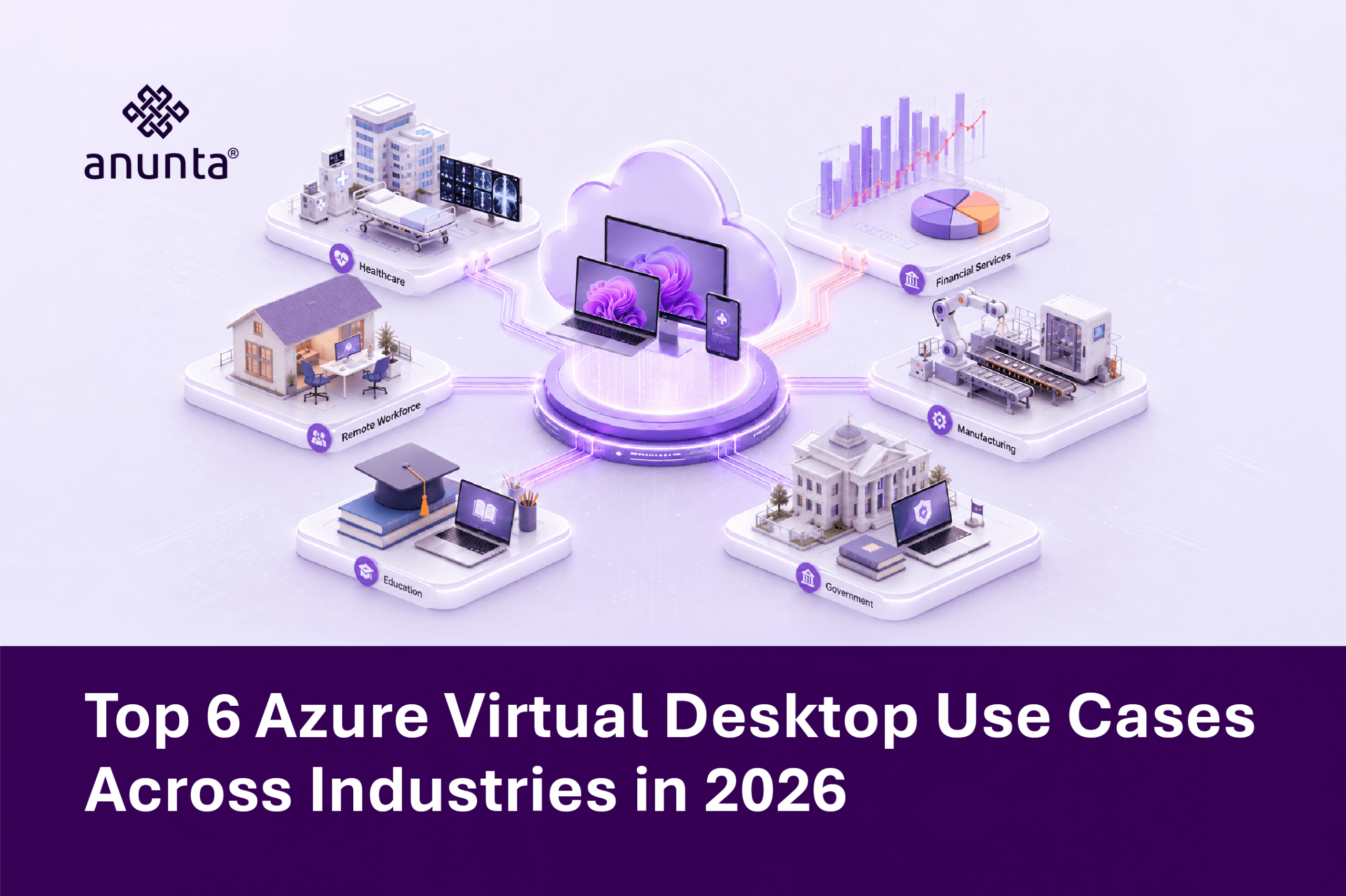
The following 6 use cases show why AVD has become one of the most effective solutions for enterprise environments.
Healthcare providers must balance patient accessibility with compliance with strict regulations.
As clinicians travel from location to location on different devices, they access sensitive patient records. Traditional access models introduce potential data governance gaps and increase the risk of non-compliance with regulations.
Azure Virtual Desktop (AVD) centralizes clinical workspaces, enabling users to keep patient data in Azure while providing security features such as role-based access controls, multi-factor authentication, and conditional access. This enhances security and creates a seamless environment where clinicians can access both applications and patient records.
Because data is rendered for streaming rather than being stored locally, even when a clinician loses or has their device stolen, they do not risk disclosing patient information.
Anunta helps healthcare organizations develop secure digital workspaces that ensure compliance and operational efficiency. By leveraging Anunta’s managed endpoint services for healthcare, AVD helps simplify clinical workspace management while improving governance.
Clinical mobility without compliance liability.
For organizations using Azure Virtual Desktop for healthcare and BFSI, AVD provides the flexibility and security necessary to operate in highly regulated environments. It also supports Azure Virtual Desktop security compliance and initiatives for regulated industries.
Regulatory compliance requirements are increasing in number and scope across Banking, Financial Services, and Insurance organizations. Organizations can no longer easily demonstrate compliance with these requirements while also supporting an increasingly distributed workforce and partner ecosystems.
Azure Virtual Desktop offers a single architecture with centralized governance-based logging, monitoring, and policy enforcement. Data Loss Prevention controls help reduce the risk of inappropriate information sharing, and Conditional Access enhances identity security.
Audit readiness improves dramatically as audit evidence can be generated faster and with greater consistency.
Additionally, Azure Virtual Desktop’s ability to scale in ways that reduce overall complexity and simplify the onboarding of contractors, advisors, and seasonal employees has redefined how institutions operate.
Through its cloud VDI deployment services, Anunta assists organizations in meeting their digital workspace strategy while aligning regulatory compliance with enterprise business objectives.
Regulatory compliance posture that is aligned to, and scales with, an organization’s business, not at cross-purposes with it.
As a result, Azure Virtual Desktop security compliance, compliance with regulated industries, and AVD solutions for enterprises continue to gain momentum across BFSI.
Manufacturers are trying to upgrade their facilities, but are unable to do so due to cyber threats in the operational technology world.
As the Industry 4.0 movement establishes connections between enterprise and plant systems, the need for a secure way to access them has increased substantially.
With Azure Virtual Desktop, manufacturing workforce members work in a separate environment from the physical plant’s OT environment; therefore, users can access ERP and MES applications without direct access to the OT infrastructure.
An industry-leading global manufacturer of flat-rolled steel partnered with Anunta to improve the performance of Azure Virtual Desktop across multiple locations worldwide. Following Anunta’s comprehensive assessment and performance optimization of the AVD environment, Anunta improved user experience and operational stability, creating an AVD-enabled environment that will support the manufacturer’s future business expansion.
The collaboration has shown that AVD sustainability depends as much on continual performance optimization as on initial deployment.
For manufacturers, Anunta’s expertise in cloud VDI deployment on Microsoft Azure helps turn AVD into a secure, scalable foundation for enterprise initiatives.
Hybrid work has become a permanent business reality.
To support hybrid work, organizations must enable employees to work across multiple devices, locations, and networks while maintaining security and governance.
Azure Virtual Desktop provides a consistent user experience across endpoints. In addition, team optimization improves collaboration performance, while FSLogix profile containers ensure seamless user experiences across sessions.
Employees gain flexibility. IT teams retain control.
Organizations also benefit from reduced VPN dependency and simplified access management.
By integrating AVD with broader Microsoft 365 managed services, Anunta helps enterprises create secure, scalable workplace environments that support productivity and governance.
Hybrid work that IT can actually govern.
As a result, AVD continues to deliver measurable AVD benefits for the remote workforce, support virtual desktops for hybrid work in Microsoft 365, and drive cost-optimization initiatives for Azure Virtual Desktop.
Educational institutions face highly variable technology demand, so traditional computer labs require significant investment during peak usage, often leaving infrastructure underutilized throughout the year.
Traditional computer labs require significant investment during peak usage, often leaving infrastructure underutilized throughout the year.
Azure Virtual Desktop replaces this model with on-demand computing. As demand changes, auto-scaling capabilities provision resources when needed and scale down when demand decreases.
Students gain access to powerful computing environments regardless of device limitations, while faculty can securely access specialized software without complex installations.
In addition, Anunta helps institutions build flexible digital learning environments that improve accessibility while optimizing technology investments.
Lab-quality compute for every student, without lab-sized capital expenditure.
For institutions focused on Azure Virtual Desktop cost optimization, AVD remains one of the most practical solutions for enterprise education environments.
Automotive innovation depends on collaboration across suppliers, contractors, and engineering partners, while organizations must also protect valuable intellectual property and design assets.
At the same time, organizations must protect valuable intellectual property and design assets.
Azure Virtual Desktop provides secure engineering workspaces that allow suppliers to access only the resources required for their projects. CAD and PLM applications run securely within Azure, while files remain inside the governed environment.
Access can be provisioned quickly and revoked immediately when projects conclude.
In addition, Anunta helps automotive organizations establish secure engineering environments through Azure Virtual Desktop security frameworks and governance controls.
Design collaboration without design data, leaving your control.
As a result, Azure Virtual Desktop managed services, Azure Virtual Desktop security compliance, and strategies for regulated industries are increasingly important across the automotive sector.
6 Industries; 1 Clear Finding
Organizations get the most value from Azure Virtual Desktop (AVD) when technology decisions and business outcomes are aligned.
No matter whether you are looking to meet health care compliance, achieve financial governance, modernize manufacturing operations, support remote workers, improve access to education, or protect your intellectual property, AVD has delivered the best results when backed by expert support.
Anunta is a worldwide digital workspace specialist. By partnering with us, organizations drive faster adoption, reduce costs, enhance security, and provide a better user experience in their enterprise environment.
Ready to assess Azure Virtual Desktop for your environment?
Contact Anunta’s AVD experts and receive a tailored deployment scope within 48 hours.
1. What is Azure Virtual Desktop, and how is it different from traditional VDI?
Azure Virtual Desktop is Microsoft’s cloud-native desktop virtualization service, delivering Windows 10/11 virtual desktops from Azure to any device. Unlike traditional VDI, there is no on-premises hardware to maintain, licensing is consolidated under Microsoft 365, and scaling is automated based on actual usage.
2. How does AVD support regulatory compliance in regulated industries?
AVD is built on Azure’s compliance infrastructure, which covers HIPAA, PCI-DSS, SOX, ISO 27001, and regional frameworks. Built-in tools – including conditional access, DLP, RBAC, and Azure Monitor audit logging – allow regulated organizations to demonstrate control evidence without custom tooling.
3. How long does an AVD deployment take with a managed services partner?
Most production-ready AVD deployments with an experienced managed services partner are complete within 4 – 8 weeks, including security hardening and Microsoft 365 integration.