Enterprise perimeters have shifted from being confined within data centers to extending to the edge of the organization, including laptops, smartphones, thin and virtual desktops, and IoT devices.
Today, over 70% of all successful cyberattacks begin at endpoints. With the rise of distributed work, adoption of cloud-based solutions, and implementation of Zero Trust architectures, the enterprise attack surface has expanded significantly. As a result, understanding what managed endpoint services are is not only an IT concern but also a business imperative.
Managed endpoint services provide centralized, SLA-based security, monitoring, lifecycle governance, and performance management across the entire endpoint environment. Instead of managing fragmented devices reactively, enterprises gain predictive intelligence, unified visibility across their device environment, and reduced risk simultaneously.
For organizations operating at scale, enterprise endpoint management services are not just a nice-to-have but a critical component for maintaining business continuity and regulatory compliance.
Managed endpoint services refer to a set of continuous, intelligence-led, outcome-driven, risk-aligned, proactive, and centralized Management, monitoring, and security for all enterprise endpoints within an organization, under specific service-level agreements (SLAs).
Managed endpoint services for enterprises differ from traditional, tool-based endpoint management models. They provide:
They typically cover:
Using a unified governance structure to replace siloed IT processes, enterprise endpoint management governs and transforms enterprise endpoints from operational costs to controlled, secured digital assets.
To fully understand what managed endpoint services include, it is essential to recognize that today’s services combine endpoint security, lifecycle governance, and performance optimization into a single framework.
Enterprise Endpoint Security Management Services
The primary reason businesses have managed endpoint security services is security. The capabilities of enterprise endpoint security management services are:
By providing enterprise endpoint security management services, businesses reduce dwell time, limit lateral movement, and enforce hardened configurations aligned with Zero Trust standards. The measurable impact will be improved speed in detecting and responding to threats, resulting in decreased potential for disruption and increased overall cybersecurity resiliency.
Unpatched devices remain a primary driver of breaches. Enterprise Patch Management Services align continuous security posture with security baselines using:
Implementing automated endpoint patch management enables businesses to transition from a reactive remediation approach to proactive risk mitigation.
Unmanaged device sprawl creates compliance and visibility issues. Device lifecycle management for enterprises establishes governance for:
Integrating lifecycle intelligence into managed endpoint services eliminates shadow IT and enhances audit readiness.
Productivity suffers when security takes precedence over performance. Endpoint-monitoring services combined with proactive endpoint management can efficiently deliver:
The benefits of managed endpoint services extend beyond security. They also have a direct positive impact on user experience and employee productivity.
To better understand why enterprises need endpoint management, it is helpful to look at their growing complexity. Today’s organizations work in:
This creates:
There is no denying that enterprises use managed endpoint services to survive and grow safely, not just for convenience.
Managed endpoint services have both operational and strategic benefits. That includes:
From a security perspective, managed endpoint security benefits include:
This allows enterprises to move from being vulnerable to trusted entities on their endpoints.
Understanding the distinction between managed and traditional endpoint management highlights the strategic shift.
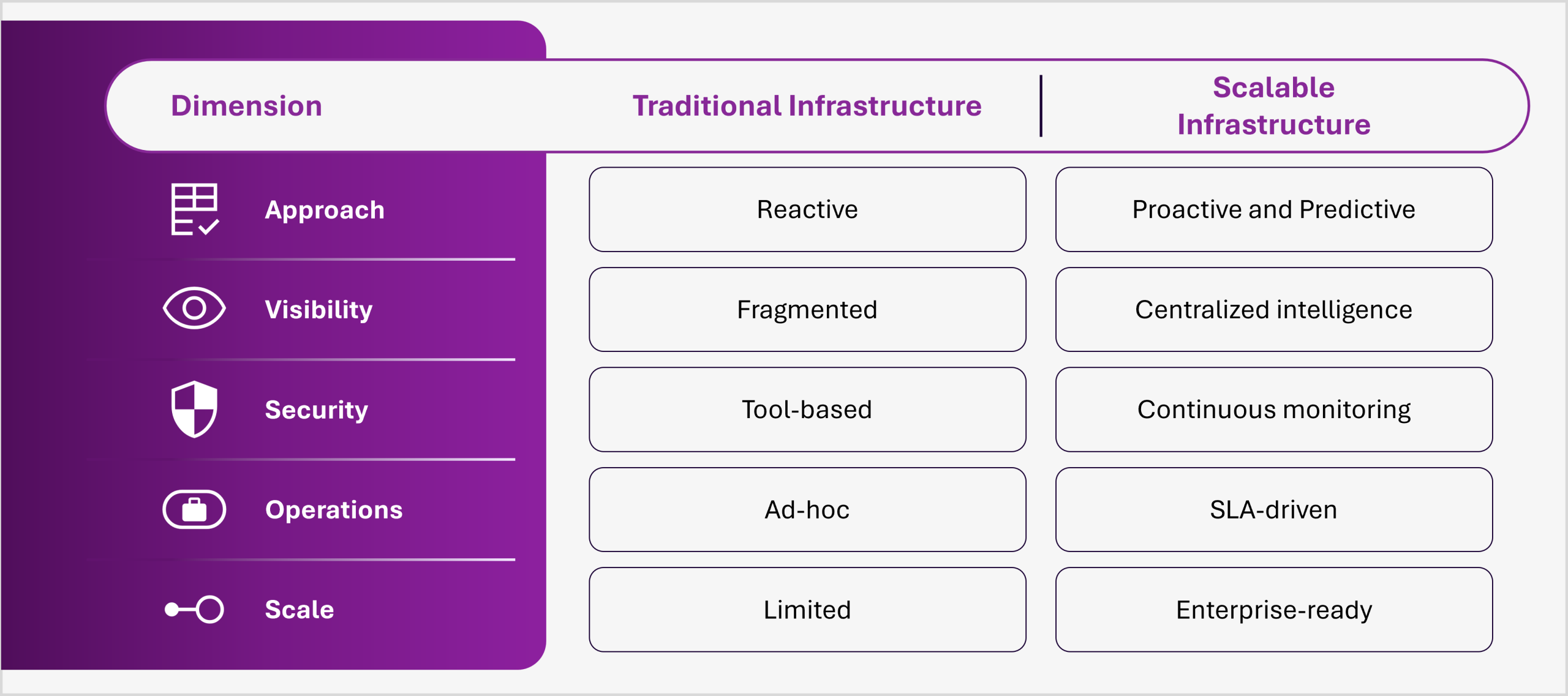
This enterprise endpoint management comparison demonstrates why legacy models fail at enterprise scale.
Managed endpoint services for large enterprises are especially critical in regulated and distributed environments.
In addition to compliance, governance, and security, the following sectors require effective endpoint management:
Managed enterprise endpoint services provide the appropriate level of structured oversight needed for secure scalability in these environments, as regulated industries cannot rely on fragmented device controls to meet compliance, governance, and security requirements.
When evaluating managed endpoint services for the above sectors, organizations should consider strategic capability beyond just tooling.
An effective enterprise endpoint management provider should demonstrate:
The right provider becomes an extension of the enterprise risk posture.
Managed endpoint services have shifted from a technical support function to a core enterprise risk management solution by centralizing services for enterprise endpoint management. By centralizing enterprise endpoint management services, organizations will experience:
In today’s distributed enterprise world, endpoints represent both productivity and risk. This is why enterprises can no longer afford to wait for managed endpoint services to become a future investment and must view them as critical and immediate.
1. What are the differences between managed endpoint services and endpoint management?
Endpoint management is the function of managing and controlling endpoints; managed endpoint services is a complete, outsourced, proactive model based on SLAs that includes endpoint security, monitoring, patching, and lifecycle management.
2. Are managed endpoint services made for large enterprises?
Yes, managed endpoint services are ideal for large, distributed, and regulated enterprise organizations that need a centralized management model.
3. How will managed endpoint services help to increase my security profile?
We reduce security risks by continuously monitoring your systems, automatically patching vulnerabilities, and responding to threats immediately.
4. Do managed endpoint services allow for the Management of remote or hybrid workforces?
Certainly, managed endpoint services can provide secure, centralized Management regardless of geographic or device location.
5. What types of devices are included in the managed endpoint services?
Laptops, desktops, mobile devices, virtual desktops, thin clients, and, more recently, IoT devices.