An IT metric is no longer associated with speed; rather, it has become a competitive edge in today’s fast-paced global enterprise market, where operational capacity is lagging behind the velocity of strategic intent. The rapidly changing nature of markets leads to rapid risk repricing, while many organizations still have infrastructure designed for stability.
Additionally, organizations are facing rapidly changing customer expectations and increased regulatory scrutiny with little to no notice. The result is a gap between operational capability and the pace at which strategic objectives change/adapt.
To close that gap, there must be an adaptive infrastructure, not simply by refreshing IT infrastructure via the cloud or implementing incremental automation, but through redefining how enterprise IT senses/develops information and makes/executes decisions in real time.
The issue for enterprises today is no longer whether they should update their infrastructure. Rather, the question is whether the current architecture can keep up with the organization’s growth/aspirations.
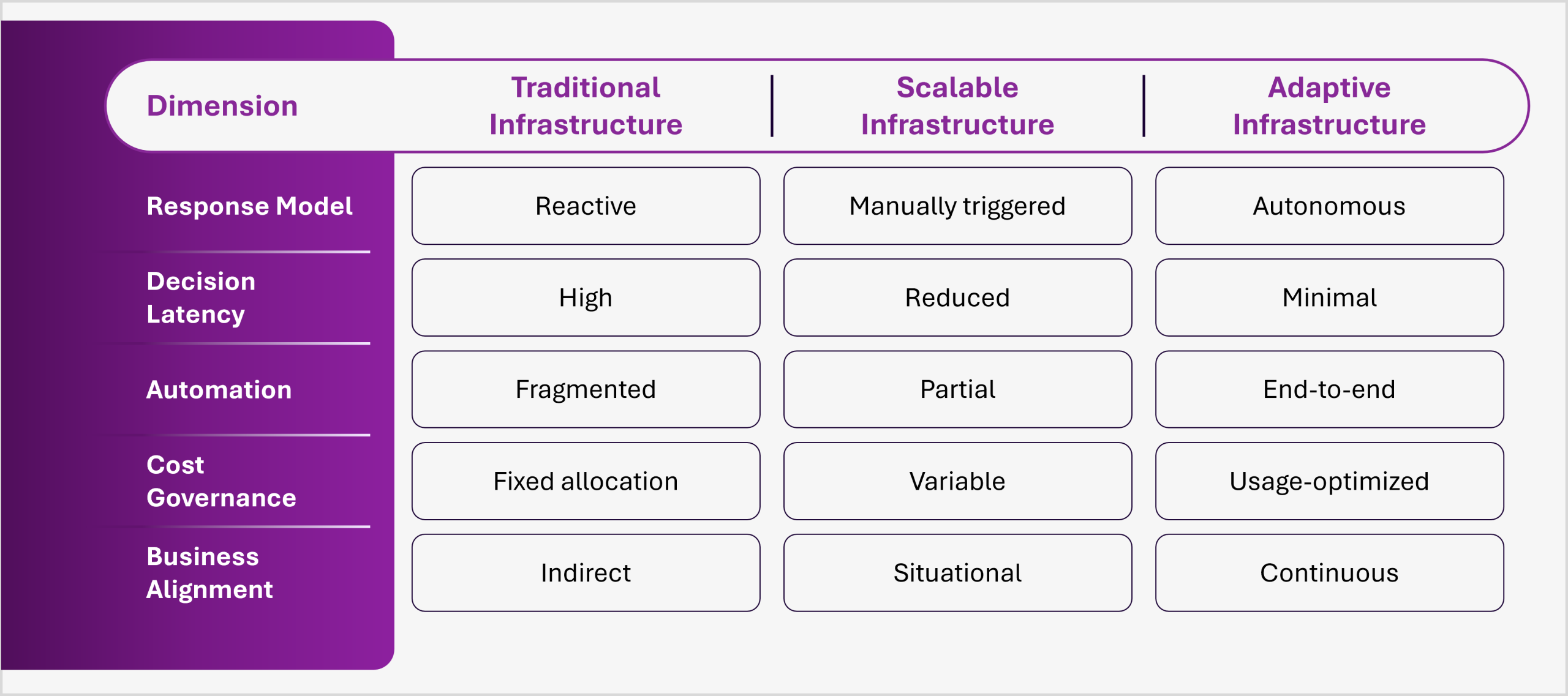
People often confuse adaptive infrastructure with scalable IT. This is an incomplete view of the two kinds of infrastructures.
Scalability increases capacity. Adaptability reduces time. True adaptive IT infrastructure is a policy-driven, telemetry-enabled architecture that continuously aligns compute, storage, network, and digital workspace infrastructures with live business signals, without requiring manual intervention.
The three non-negotiable elements of true adaptive IT infrastructure are:
This is not about modernizing. This is about creating a modern infrastructure for Digital Transformation.
Many organizations believe they are adaptive because they operate in the cloud. That assumption is dangerous.
Cloud without orchestration is still manual. Automation without policy is still reactive.
Adaptive infrastructure vs traditional infrastructure is measured by how quickly the enterprise can move, not how modern the environment appears.
There is a measurable value associated with all time lags between a signal and its action, including:
Each decision-making cycle will be affected by the combined effects of infrastructure latency.
An adaptive infrastructure for business speed eliminates friction in three key process intervals:
The more that execution becomes autonomous, the greater the increase in business throughput without a corresponding increase in headcount. This is the operational leverage created by enterprise adaptive infrastructure.
In real-time infrastructure environments, there’s constant telemetry across all applications, endpoints, and digital workspaces, so executives don’t need to rely on lagging dashboards. They will now be making decisions based on live intelligence, enabling them to accelerate their ability to make intelligent business decisions through an adaptive IT Infrastructure.
Metrics, logs, traces, and User Experience Analytics are collected and displayed in a single operational view. Infrastructure observability removes blind spots and reduces diagnostic time. Organizations are moving away from troubleshooting and into foresight.
Policy frameworks allow on-the-fly scalability (adding capacity), workload redistribution, and performance optimization to be executed when thresholds are met. This is the result of automated infrastructure management.
IT teams will now spend all their time on transformations rather than on routine operational tasks, since we have removed routine operational intervention.
At Anunta, we embed adaptive infrastructure solutions into managed digital workspace ecosystems to sustain velocity across endpoints, applications, and Digital Infrastructure Layers.
New ideas are not the only thing holding back innovation. Innovation is hindered by structural friction, which inhibits development in existing organizations. Organizations can eliminate these bottleneck issues by implementing adaptive infrastructure for product development.
Organizations with cloud-native, adaptive infrastructure have improved their CI/CD processes by deploying application environments at scale without delays in provisioning.
Cloud-native, adaptive infrastructure improves support for container orchestration and microservice architectures through auto-healing capabilities.
With real-time infrastructure, organizations can instantaneously replicate application deployment environments and quickly perform automated application rollbacks if they determine the deployed version of the application is defective.
Eliminating delays in provisioning environments enables faster innovation, which is a competitive advantage.
While improving operational efficiency and controlling costs, accelerated growth may lead to increased operational stability. Organizations with adaptive infrastructure operational efficiency models integrate financial discipline.
An automated resource allocation system allocates the required levels of compute, storage, and network traffic in accordance with real-time workload demand.
Assuring the application environment can expand and contract automatically in response to workload demand, scaling, and flexibility.
Costs can be optimized by using flexible systems that provide real-time utilization analytics, replacing forecast-based estimates of resource requirements with actual use data.
Consumption-based models enable cost control in adaptive infrastructure environments.
Anunta combines policy-based automated processes with consumption governance policies to ensure the enterprise’s adaptive infrastructure is aligned with its financial discipline.
Speed and resilience must go together.
Adaptive infrastructure vs traditional IT infrastructure clearly demonstrates how resilience and velocity coexist.
The most common adaptive infrastructure use cases are those that involve speed, compliance, and volatility, such as:
Across industries, adaptive infrastructure for enterprises enhances competitive durability.
Implementing an adaptive IT infrastructure requires structured execution.
Anunta’s phased maturity model ensures that adaptive infrastructure solutions are not experimental; they are enterprise-ready, compliant, and scalable.
Adaptive infrastructure is the hidden engine of modern enterprise velocity. It enables:
In volatile markets, the competitive edge belongs to organizations that combine speed with governance. Adaptive infrastructure for digital transformation is not optional. It is foundational.
FAQs
1. What defines adaptive infrastructure?
A telemetry-driven, policy-governed architecture that autonomously aligns resources with live business conditions.
2. How does it improve enterprise speed?
By compressing signal-to-execution intervals, eliminating manual provisioning delays, and enabling autonomous scaling.
3. Is it limited to cloud environments?
No. Adaptive infrastructure spans cloud, hybrid, and endpoint ecosystems through orchestration and automation frameworks.
4. How does it support digital transformation?
It removes infrastructure bottlenecks, enabling continuous innovation and real-time responsiveness.
5. Who benefits most?
Enterprises operating in regulated, high-velocity, or demand-volatile industries where execution speed determines market position.